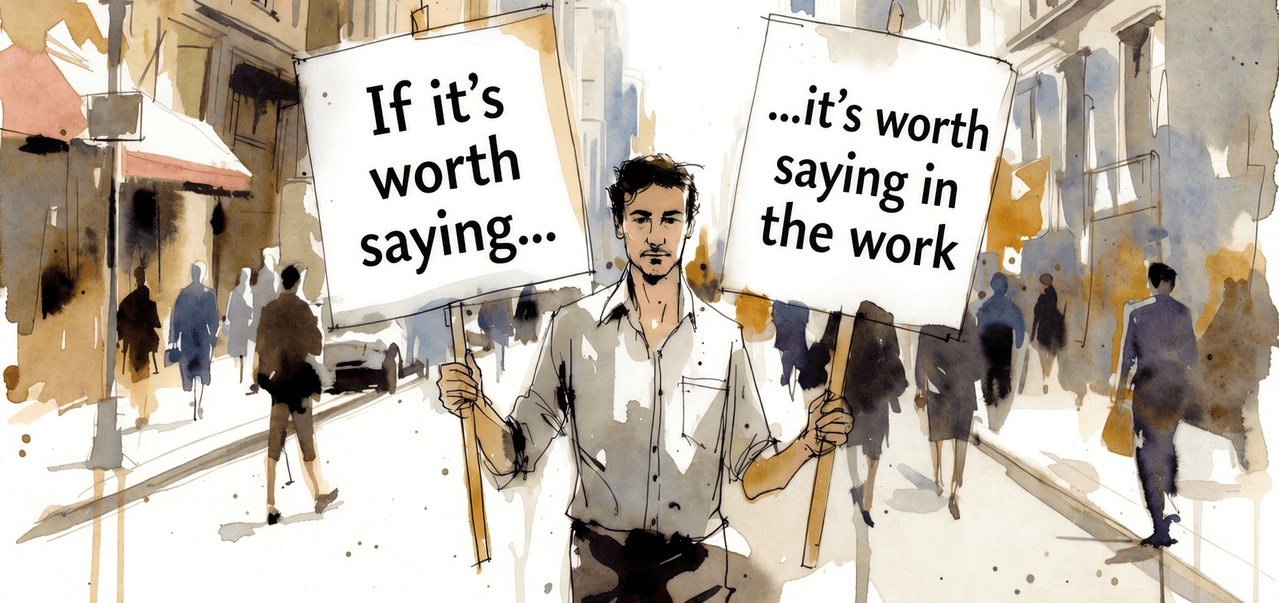
Most experts who’ve worked through the case against political posting in professional settings arrive at the same place: I accept the argument, but what do I do with my convictions?
In the first two articles of this series (Part 1; Part 2), we worked through why the feed is the wrong venue for most of what you want to say politically.
It’s worth separating two things before we go further, because most people conflate them, which is part of what makes this hard.
When Indie-experts feel the pressure to post politically, they usually experience it as pressure to express their values. Political conviction and personal values feel identical in the moment. They’re not always.
Here’s the difference: Your values are already woven into your work, while your political convictions are often specific positions on contested questions that feel newly urgent with every news cycle.
The conviction already embedded in your work is doing its job. The conviction still looking for a channel needs to pass a different test.
The Promise You Already Made
That test is the same for every channel, and by “channel” I mean the places you publish online. Instead of asking, “where can I say this?” Ask instead, “What is this channel for, who opted into it, and what promises did I make them?”
Answer those three questions honestly for each channel, and the political posting question mostly answers itself.
The principles we’ve been discussing throughout this series apply everywhere you publish – your articles, website copy, email newsletters, and social profiles.
Your articles and website are where you build your body of work. And that work already carries your deepest convictions. They reveal themselves in the problems you choose to address, the clients you serve, the approaches you advocate for, and those you refuse.
Consider the practitioner who consistently frames a client’s struggle systemically rather than symptomatically – who won’t reduce a person’s pain to a behavior to be corrected. That’s conviction. The methodology is the position.
When you publish how you think – consistently, over time – you build a body of work that allows your readers to piece together what you believe from what you choose to write about. They arrive at your values on their own.
Your email list is the most intimate channel you have – people who gave you their address because they trusted the initial promise you made when they joined.
Using the list to test whether they share your political affiliation is a different transaction than the one they agreed to. You can create a separate channel for that. What you can’t do is route it through the expert list and call it authenticity.
Your social media profile is your primary doorway for people who don’t know you yet. Your ideal prospect lands on your profile, reads your bio, and scrolls through your last ten posts. They’re building a picture of what you do and who you do it for.
You never know what day they’ll find your account, and if your latest posts include that political detour—something that doesn’t fit that picture —they don’t think, “oh, this person is so complex.” Instead, they think, “I must have been wrong about who this is and what they can do for me.”
Then they leave.
If You Want to Take a Stand, What Moves the Needle?
When your convictions merge with your values, and you want to speak up, where do they go?
Two of the most effective approaches to advocating for a controversial position are also a lot more difficult than typing a rant into X at 2 am. And that’s precisely why they’ve worked for generations.
The first approach is your own writing, through translation.
Earlier, we talked about your articles and body of work already carrying your deepest convictions – in the problems you choose to address, the clients you serve, the approaches you advocate for.
What we’re talking about now is writing that takes a specific political or social conviction and finds the universal thread inside it.
It’s not easy, but it is powerful when done well.
First, Back Away from the Heat
Begin with your conviction at its hottest, and back up until you find a common point of agreement, and build from there.
Take the position that makes you angriest. Now strip away the opponent and the specific policy. What’s left? Usually a value, a fear, or an underlying human concern most people already share: safety, fairness, dignity, or belonging. That’s your starting point.
As you write, keep one question in the back of your mind: could someone who disagrees with you read this without feeling attacked? If the answer is no, back up further. Find what you both wish were true.
Now there’s an artful, convincing way to do this, and an approach that doesn’t work.
Here’s a great example of the approach that doesn’t work. In the early 80s, a band called Culture Club released a song that began: “War, war is stupid. And people are stupid.”
You could tap your toe to it, and you wouldn’t find many on the dance floor disagreeing with the first assertion, but I don’t think many warlords were second-guessing their strategy.
The message was about as subtle as an LA phone book landing with a thud on your doorstep.
Contrast that “protest song” with Bob Dylan’s Blowin’ in the Wind. He never names an enemy or takes a side. He asks “how many roads, how many seas, and how many years,” and leaves the answer with the listener.
Which is why the first song is a forgotten novelty, and the second still attracts listeners who weren’t alive when it was written.
Why Translation Works
The best songwriters and poets take a difficult, painful reality and pair it with a question or recognition the listener can step into without first joining a side. The specific pain is still there; it just isn’t locked behind a wall that only the already-convinced will climb.
By exploring the issue through universal themes we can all embrace, an ordinarily polarizing issue can potentially change hearts and minds.
Another example is one of my favorites. Paul McCartney wrote Blackbird in the days after Martin Luther King’s assassination. McCartney translated what he felt about the event and oppression into a single image – a bird learning to fly on broken wings – something anyone who had ever felt silenced could accept without being handed a political affiliation first.
He didn’t take a side; he transcended sides by focusing on universal themes and the values we all share.
You have the same kind of opportunity in your writing.
Yes, this is harder than posting hot takes. It asks you to find what’s genuinely universal inside the specific outrage, and then write toward that.
Writing can do this work, but there’s a more direct route too.
Second, Think Globally and Act Locally
Yes, that line has become a platitude, and it also carries a seed of truth. We can be concerned about endless global issues, yet the action that moves the needle is local and in person.
In part two of this series, we discussed how futile it is to attempt to influence a global audience on social media.
Local, on the other hand, is where influence happens: Person-to-person, small groups, one conversation at a time.
Local has something social media will never have: On social, you’re a name and an avatar. In a local professional circle, you arrive with a history and a reputation.
Local works because of the repeated contact in environments where no one’s identity is on the line. Nobody showed up to your professional association meeting to defend their tribe. They came because they’re in the same field or neighborhood and deal with the same problems.
Contrasting local, in-person environments with online feeds is the “water” Jonathan Pageau was referring to in part two. You don’t change minds; you change the conditions in which minds change.
None of this feels as dopamine-charged as the feed can be, and that’s the point. The feed feels more dramatic because the numbers are immediately visible.
Local, in-person work feels comparatively insignificant because there’s no stat counter measuring response in real time. But that counter measures attention, not conversion.
Local work measures neither – it just actually changes things. The person who left that conversation went home and rethought a position they’d held for years. That kind of change doesn’t show up in an analytics dashboard.
If the conviction is real, it deserves a worthy venue, and the feed isn’t that venue. Writing that transcends politics is. So are the circles where you have history and a reputation.
A Checklist for When You’re Running Hot (Or Feeling Pressured)
I understand the outrage, the anger over the news cycle. I’ve been there. And jumping online to vent is one of those times to count to ten before acting.
As strong as that feeling can be, what you’re feeling is often the belief under pressure, not the belief in its truly productive form. While the conviction may be real, the heat usually isn’t.
You had a feeling, the platform offered a button, and the audience became the target.
The same holds when you’re feeling pressured by a peer group, especially one you respect. Run those feelings through this checklist and see what emerges on the other side.
The framework from part one – Domain, Relational, Factional – is really just one question asked multiple ways: is this speech clarifying my work and serving the people who came for it, or have I drifted into Factional territory?
The checklist below runs those same tests when it’s hardest to think clearly.
That momentary feeling will lie. This checklist won’t.
The Inverse-Offer Test.
Read the post and ask: who did I just announce I’ll stop working with? If you can’t name them, you are not positioning – you are venting.
Positioning is a door you close on purpose. Venting with hot takes slams random doors and calls it courage.
The Client test.
Write the post. Then finish this sentence: “With a paying client in front of me, this means we will ___.”
If the blank is “have a productive conversation about their actual problem,” keep going. If the blank is “know that I am right,” delete it. If you can’t fill the blank without flinching, it’s a diversion.
The Book vs. Feed test.
Would this paragraph survive in the book you are trying to be known for? Not the memoir of your opinions. The teaching book.
A book assumes your reader’s still with you on page 47. A feed assumes they’re already gone. Book-speech earns trust across chapters. Feed-speech earns the next three seconds. They’re not the same skill, and most people are practicing the wrong one.
The Consent Test.
Did these people raise their hand for this topic? A list that opted into “how to publish without becoming a content mill” did not opt into your reading of a court decision.
Authenticity without consent is performance, and your audience didn’t buy a ticket.
The Cooling Rule.
Nothing political goes out the same day you get triggered. Draft, date it, wait. Twenty-four hours is amateur prevention. Seventy-two is professional.
If the post still feels necessary after the heat drops, run the other tests. If it feels slightly embarrassing, that was never a conviction. That was a spike. (Most house fires start as spikes.)
The Empty-Room Test.
Would you post this without applause or even an audience? Would you say it to one client who disagrees with you and still needs your help this month?
If the post only works as performance, it’s not part of your offer. Offers work with a specific group of people sitting in front of you, while performances need a crowd of strangers.
The Dopamine Audit.
Before you publish, name the sensation you’re experiencing in one word: useful, superior, scared, doubtful, lonely, righteous.
Useful can ship.
Superior, scared, doubtful, lonely, righteous can wait. You can implement this audit instantly by stating the feeling out loud as you feel it. Naming it breaks the spell.
Signal Discipline
People ignore this advice when it sounds like I’m telling them to “be smaller.” I find it’s more helpful to think of it as making your signal more laser-focused and much more valuable.
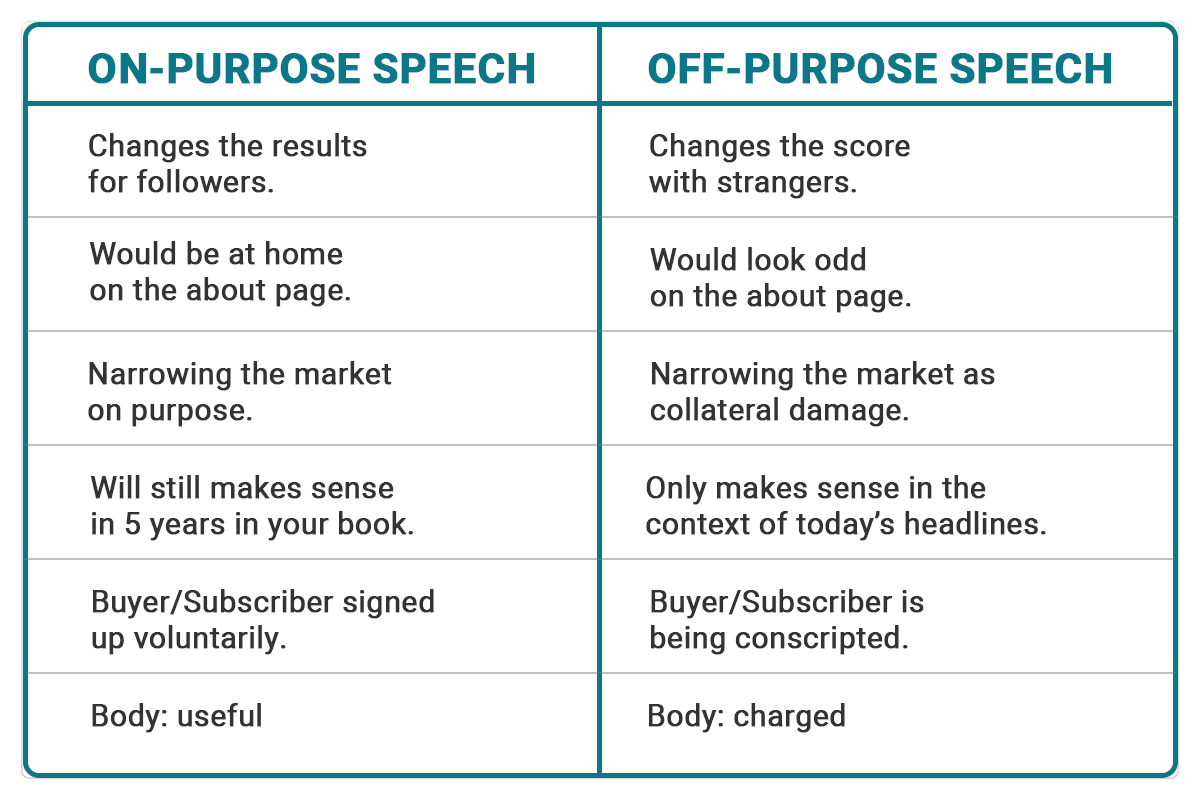
What the seven tests above have in common is that they all ask the same question from a different perspective: “Is this mine to say, here, to these people, right now?” which is a question your nervous system can’t answer when you’re running hot. It needs a framework to come back to.
That’s what the simple chart below offers: On-Purpose is the speech you built your authority and platform around. Off-Purpose is the speech that the heated moment is trying to borrow your platform for.
Some of it will look compelling. Some of it will look like courage. It’s often neither.
If it helps, keep this beside your draft window. When something feels urgent but slightly off, check the column it belongs to.
Tatemae and Honne: A Return to Professional Boundaries
At the beginning of this series, I wrote that one of my objectives was to help restore a level of professionalism that acknowledges the wall between public and private.
A friend of mine recently returned from a trip to Japan, and she was struck by how polite everyone seemed. When she asked her guide about it, he explained the contrast between their public-facing behavior and their true, private feelings: tatemae and honne.
Tatemae is the public face you wear to maintain harmony, while honne is what you actually think, kept strictly for those closest to you.
As we talked about in the first article, we used to have a version of this in the West. It wasn’t about being dishonest or inauthentic; it was about being professional.
There was an unspoken rule about politics and religion in shared spaces, which kept a certain kind of heat out of places where people wanted to peacefully coexist. A colleague’s beliefs weren’t your business unless they made them so.
And as we know, that cultural expectation has been dissolving.
The professional wall wasn’t a wall against your beliefs. It was a wall that protected the people on the other side of the room – the ones who hadn’t signed up to be given a loyalty test when they asked you for help.
That was once considered ordinary professionalism. Today, it’s viewed as radical restraint.
I think for most of us, it’s just common sense.
The True Loyalty Test
If you feel like you’re constantly walking a tightrope – trying to be visible while fearing the “loyalty test” of the current digital landscape – you aren’t alone. You’re just operating in a culture that has forgotten the value of a demilitarized zone.
So: back to the first article where I mentioned the gentleman in the workshop who asked whether I was saying he should never take a stand.
No. That’s not what I’m saying.
You are always two people – the expert your audience hired, and the citizen you also happen to be. The question that matters isn’t whether to have convictions. It’s which of those two people gets to speak, on what platform or channel, and to whom.
The man in that workshop wanted to know if he was allowed to stand for something. Of course he is. So are you.
The question that actually takes more than four minutes to answer is where standing for something does the most good – and for whom. Everywhere is not an answer. That just adds to the noise.
The loyalty test the current culture runs is punitive — perform the right signal or be cast out. But there’s an older one, and it runs the other way.
The person who hired you, subscribed to you, showed up for you — they extended trust before you said a word. They came first. They trusted first. That’s the loyalty test worth passing.


Leave a Reply