You know that story about the plane that keeps drifting off course? You’ve probably heard it at least three times this year.
I’m going to use it because the version that gets passed around leaves out the best part.
It goes something like this: On that last flight you took, the pilots don’t just point the jetliner at the destination, hit “go,” and then sit back while the plane remains locked on course the entire journey.
Right after takeoff, the plane begins drifting—a little wind here, some turbulence there, a slight course change. Most of the time, the plane drifts off its planned path. The autopilot (or the pilots) keeps noticing the drift and nudging it back, over and over.
That’s how it still shows up on time at the right airport.
The Part of the Plane Story Everyone Leaves Out
Now imagine you’re sitting on the tarmac, waiting for your plane to take off.
It’s fueled, the luggage is loaded, and the pilots have been given the all-clear for takeoff.
Except nothing’s happening.
The pilots are having a heated discussion with the tower. One pilot points out they are scheduled to go to Chicago. The other says, “We have enough fuel to go to Hawaii. I’m sure all these people would much prefer sun and sand!”
And back and forth they go, while you sit there, because they can’t decide where to go.
Okay, that’s never going to happen, but if it does, I’m voting for the beach…
Most of Us Have Sat on Our Own Version of That Tarmac
We’re fully fueled, cleared for takeoff, and going absolutely nowhere. We’re not waiting because we’re unprepared. We’re waiting because we can’t decide.
You have the skills, the knowledge. You’re ready. You just can’t pick a direction and commit.
What if you make the wrong decision?
What if you run out of fuel?
If you’ve spent way too long deciding something – anything that actually requires you to show up and be seen – this one’s for you.
The Real Cost of Staying Grounded
The fear isn’t really about being wrong. It’s about the vulnerability of being seen trying something that didn’t work.
But the only people who never fail in public are the ones who never leave the tarmac.
There’s a trade-off here worth considering: When you’re committed to a path, being wrong only costs you an adjustment. A little time, some energy, a bit of recalibration.
Staying on the tarmac, however, costs you the entire flight. You’re trading a few weeks of effort for the reality of never going anywhere at all.
The tarmac keeps you safe from being wrong in public. It doesn’t keep you safe from the slow, private cost of going nowhere. That cost is always there. It just doesn’t show up as dramatically.
Very few decisions are actually irreversible. You can change your mind or pivot.
What you can’t do is adapt from the ground.
Collapse All That Uncertainty
From long experience, I know this about hesitation on that tarmac: the longer you wait, the more convincing the arguments for waiting become. Every day on the ground gives you even better reasons to stay there.
You’ve weighed your options. You’ve looked at that decision from every angle, probably more than once. If anything, the options feel genuinely equal – which is exactly when the thinking starts to work against you.
When all paths look viable, more deliberation doesn’t help. It just gives the hesitation more material to work with.
I’ve always loved this quote, often misattributed to Goethe, but actually written by the explorer W.H. Murray:
“Until one is committed, there is hesitancy, the chance to draw back, always ineffectiveness. Concerning all acts of initiative (and creation), there is one elementary truth, the ignorance of which kills countless ideas and splendid plans: that the moment one definitely commits oneself, then providence moves too. All sorts of things occur to help one that would never otherwise have occurred. A whole stream of events issues from the decision, raising in one’s favor all manner of unforeseen incidents and meetings and material assistance, which no man could have dreamed would have come his way.”
The end is the most quoted part, which is actually Murray tacking on a loose translation of a couplet from Goethe’s Faust:
“Whatever you can do, or dream you can, begin it. Boldness has genius, power, and magic in it. Begin it now.”
Ready to Feel Ready
I’ve quoted that passage for years. Every time I read it, I’d feel an inspired spark of resolve, as if I’d finally gotten it and was ready to move.
But I wasn’t always ready to move. I was ready to feel ready.
Looking back, the cycle was the same. I’d feel pulled toward action on that slightly out-of-reach big project, and then slowly drift back to weighing my options and watching for just one more sign that it was finally safe to begin.
I called it foresight. I had a whole vocabulary for it, actually. But I was stalling, and doing it well enough to keep even myself convinced otherwise.
What made this so tricky was that I wasn’t inactive. I was busy with plenty of things, and I was making real progress on them. But they were the work where I already thought I had a rough idea of how it would go – the familiar client projects, the comfortable territory, the projects that didn’t ask much of me where it counted.
Meanwhile, the projects I claimed mattered most, the ones I’d revisit every once in a while to remind myself how exciting they were, sat in a folder on my desktop.
Something about it wasn’t ready. Or I wasn’t. I’d have known the difference if I’d been honest about it.
What I was missing—what most of the experts I work with miss—is that the “genius, power, and magic” Murray writes about doesn’t trigger while you’re still deciding. You can spend months preparing, organizing your thoughts, and waiting for the perfect conditions, but reality doesn’t respond to your intentions or your careful deliberations.
It responds the moment you commit.
Reality Doesn’t Care About Your Intentions
Reality doesn’t shape itself around what you meant to do, or what you were hoping for, or what you would have done if the timing had been better.
Reality responds to actual commitment.
Hedging feels smart. You keep your options open, stay flexible, stay safe. But you’re actually choosing to be invisible.
When you commit to something – a direction, an audience, an idea – you take all that floating uncertainty and collapse it into one specific direction.
And reality finally has something to work with.
The stream of events Murray describes – the unexpected assistance, the unforeseen meetings, the material help that seems to appear from nowhere – none of that can find you when you’re floating in a fog of positions that could be reversed at any moment.
Most of us mistake that fog for flexibility. It’s really just avoidance.
The ego loves the safety of the fog. The problem is, the world can’t see you through it. And when others can’t see you, you can’t be pushed, challenged, or moved by life – because you’ve refused to take shape.
What Happens When You Make a Real Commitment
When you make a real commitment – when you actually put something on the line – two things happen.
First, all those stories you’ve been telling yourself about why things are the way they are suddenly have something to push back against.
Commitment cuts through those stories and dissolves them.
Second, the fog clears. We sometimes blame our invisibility on all the noise “out there,” but the fog of indecision begins with you.
Once you clearly announce your direction and act on it, the fog around you lifts. You become a beacon. You attract resources, allies, and yes, friction and obstacles, too.
All of it is the natural result of becoming a clear signal in a noisy world.
Every correction that plane makes in flight begins with a destination. Without one, there’s nothing to correct from.
You have to be airborne first.
You And Schrödinger’s Cat
Here’s another way I like to look at this.
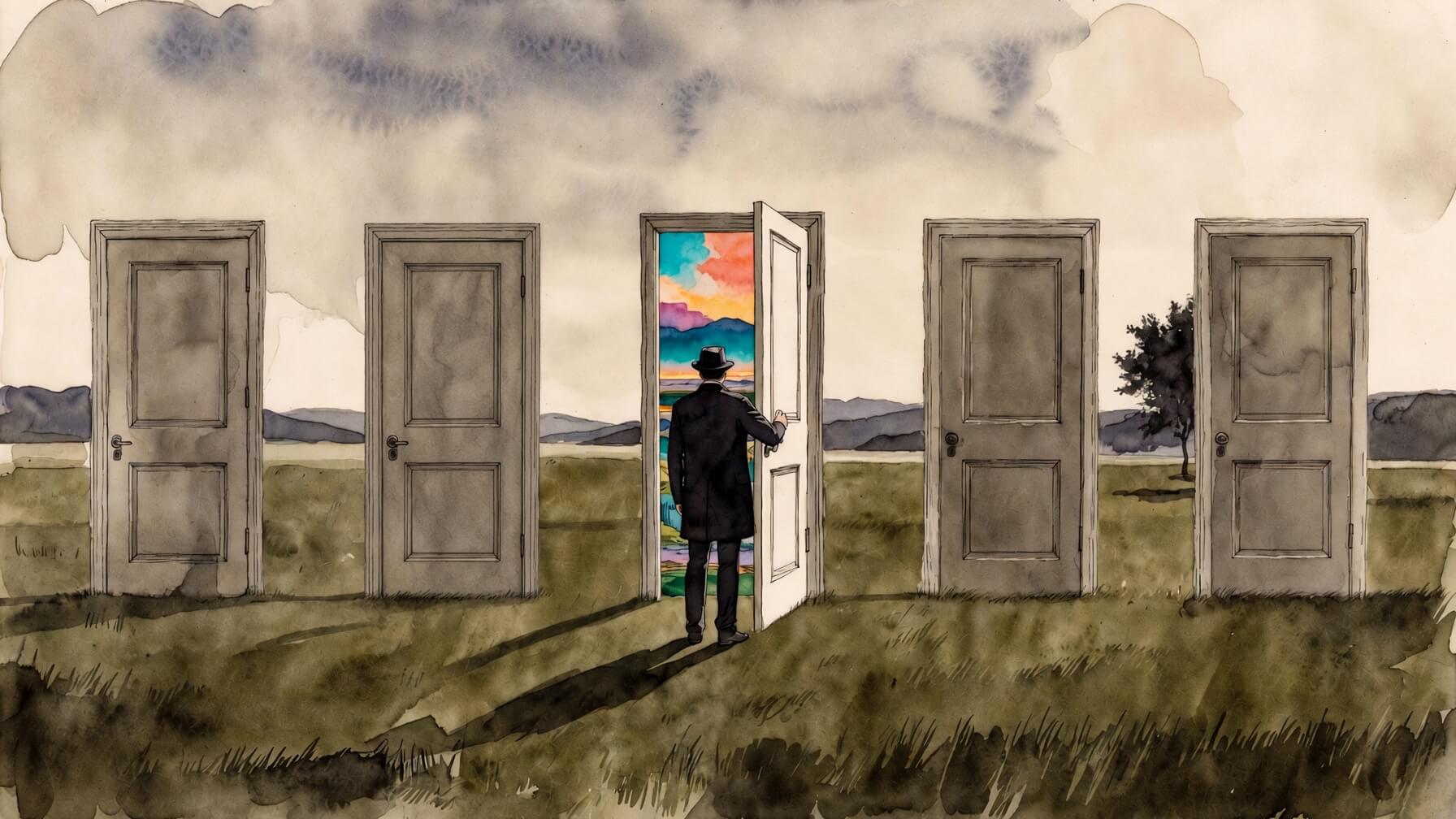
We sometimes imagine decision-making like an episode of “The Price Is Right,” where every decision is a door, each with stacks of valuable prizes, or a consolation prize, waiting behind it.
I like to think of commitment differently. On The Price Is Right, the prize is already there. The door just hides it. Open it or don’t, the cash and the “brand-new car!” exist either way.
Schrödinger’s box offers another perspective.
In 1935, the physicist Erwin Schrödinger proposed a thought experiment with a cat in a sealed box. Until you open the box, the cat is both alive and dead. The observation doesn’t uncover a result that was already settled. It settles it.
That’s closer to how commitment works. Right now, you’re holding a dozen different futures – should you stay, should you go, what happens if you wait one more month?
As long as you keep the box closed, every version of your future remains technically possible. You can be the consultant, the author, the mentor – or just stay exactly where you are, safe in the ambiguity. Unobserved.
Waiting for You to Collapse the Wave
When you haven’t yet committed to a single path, the world around you is stalled.
The people you’re waiting on – your potential clients, your collaborators, your peers – can’t move if they don’t know where to stand. They have nothing to react to. They’re waiting for you to appear from behind the fog, but you’re still busy weighing every possible version of yourself.
The path doesn’t appear because you’ve imagined it vividly enough. It reveals itself when you finally commit to one version.
As long as you stay at the intersection of every possible future, you aren’t going anywhere. You’re just lingering in some liminal state. The moment you name the date or announce the pivot, you stop oscillating and actually step into the work.
The Path Becomes Real When You Do
The Spanish poet Antonio Machado wrote: “Wanderer, there is no path; the path is made by walking.”
Most people wait for the clarity to arrive before they commit. They have it backward. Commitment is the catalyst that creates the clarity.
Only then can a client schedule a meeting. Only then can a partner see a clear enough target to start preparing.
Intentions keep your options open, which is just another way of saying you’re keeping the box closed. Commitment is the observation that ends the suspension. Once you make that move, the noise of those other potential versions finally fades away.
You stop being a collection of possibilities and start being the authority with a clear, singular direction.
Everything else has to move out of the way. And for the first time, people can actually find you.
The same principle that applies to your biggest life decisions also shows up in the one people underestimate the most: deciding what you’re actually here to write about.
One Place This Shows Up: Choosing Your Focus
For most of the Indie-experts and writers I work with, the commitment problem shows up constantly with the “niche” question. It may sound small, but a lack of focus is a primary cause of professional invisibility.
I don’t use the word niche often, because it fell out of favor when half the Instagram population decided overnight they were all multipotentialites who couldn’t possibly be boxed in.
Hey, I’m not mocking the multipotentialites. I’m married to one. But what started as a reasonable pushback on rigid niche thinking turned into a convenient excuse not to commit to anything at all. Ever.
The prevailing cry became: “How can I choose one thing when I can write about all the things? Choosing limits me.”
Your Niche Is a House, Not a Box
Here’s what they’re missing: A real niche isn’t a single subject you’re confined to. Think of it more like a house with several rooms, each with its own entrance.
An Indie-expert who dives deep into a subject will inevitably uncover a few clusters of related topics that grow naturally from the main one. That’s what you’re looking for: a handful of connected ideas you could spend years exploring without ever feeling like you’d run out of things to say.
I call those entrances Doorways. Each one sits at the top of your website or social feed, names a specific corner of your subject, and signals to the right reader: this room is for you.
The topics all fit under the same roof, but each Doorway gives you enough room to breathe, evolve, and write in your own voice without twisting yourself into someone else’s idea of what “consistent” is supposed to look like.
The niche question is just one version of a much bigger problem, though.
The same paralysis shows up when you can’t commit to a business model, can’t decide which offer to lead with, or have been “getting ready to launch” for longer than you’d care to admit.
The decision changes. The cost of not deciding is always the same.
Making the Commitment Is the Practice
In my courses, students often found themselves choosing between multiple doorways, each a possible direction.
And these weren’t people who’d rushed the process. They’d been thorough — probably more thorough than the decision warranted. They’d stress-tested every topic, imagined it into the future, and compared it against the others until the differences between them were worn flat.
And on our live calls, I could see the gears grinding. They had overanalyzed every detail, every possible outcome of choosing the “wrong” one.
After all, the topics all looked viable, which was the whole problem. When you’ve done that much work and still can’t see a clear winner, what you’re looking at isn’t a hard choice. It’s a sign you’ve analyzed past the point of useful information.
Some didn’t choose at all, and ended up paralyzed, second-guessing everything.
The Shift I Love Observing
Here’s what I loved seeing in the course forum: one student would bravely step forward, declare their four focused Doorway topic clusters, admit they felt uncertain, and ask the group for feedback.
The response was always supportive – and why not? No one knows better what you can write about and who you want to reach than you do.
I’d chime in with a few tweaks and a big thumbs up: go for it. Write a few articles for each Doorway. Put them out there. See how people react. Tweak them. Keep going.
Once they committed, they stopped waiting for clarity to arrive and started creating it.
Those students discovered that the commitment itself usually mattered most. And once they chose a focused direction, they could put all their energy into making the most of that decision, through how they engaged with the material and their audience, not by continuing to agonize over what they’d chosen.
Keeping every door open doesn’t feel like fog when you’re in it. We use words like freedom instead. Mark Manson put it well:
“The most underrated trait for a happy life is decisiveness. Our intuition is that it’s best to keep our options open. But as long as you try to keep every door open, you’ll never be able to walk through the one that matters.”
The shift is from control to ownership, from anxiety to agency. Making the right decision is exhausting. Becoming someone who decides, then commits to course correction, is freeing.
Once you’re airborne, the corrections become possible. On the tarmac, you’re just burning fuel.
But What if I’m Wrong?
You will be, sometimes. Understanding what that actually means, versus what we fear it means, changes how you approach the next decision.
We fear making a public commitment to a direction that turns out to be wrong, and having to live with that failure in full view of everyone watching.
But think about what “wrong” actually looks like in practice. You pick a Doorway, write several articles, and three months in, you find out it isn’t pulling its weight. So you swap it out for something closer to what your readers keep asking about.
That’s not failure — that’s what the pilot is doing every twenty minutes.
You Can’t Be Wrong About a Future That Doesn’t Exist Yet
If I could channel Schrödinger, I imagine he’d want us to remember that no fixed outcome waited behind that door, because the outcome didn’t exist until you looked.
Which means you can’t possibly be wrong about a future that only takes shape when you choose it.
And here’s the truth about everyone watching: they aren’t. They’re too busy worrying about their own choices to keep tabs on yours.
And for the few who actually are paying attention? They aren’t waiting for you to stumble. They’re watching to see what happens when you finally stop stalling and start moving.
That’s when the real magic begins – the feedback loop of someone else interested enough in what you’re doing to read, comment, and share.
Course Corrections Are the Work
When you commit to a direction, the work itself starts feeding you information you couldn’t have gained any other way. You get a client question you didn’t expect, or a piece of writing connects in a way you hadn’t anticipated. You adjust. Then you adjust again.
No pilot expects passengers to complain about her “wrongness” as she makes those constant, small adjustments between takeoff and landing. The destination remains the same, but the path is fluid.
You don’t need a perfect plan from the start. You need enough movement to know which way to steer.
Not one of my clients stuck with all their original topic clusters. They’d commit, and when one Doorway turned out weaker than expected, we’d shift emphasis.
You commit to an offer; it doesn’t resonate, so you refine it. That’s not failure.
That’s flight.


Leave a Reply