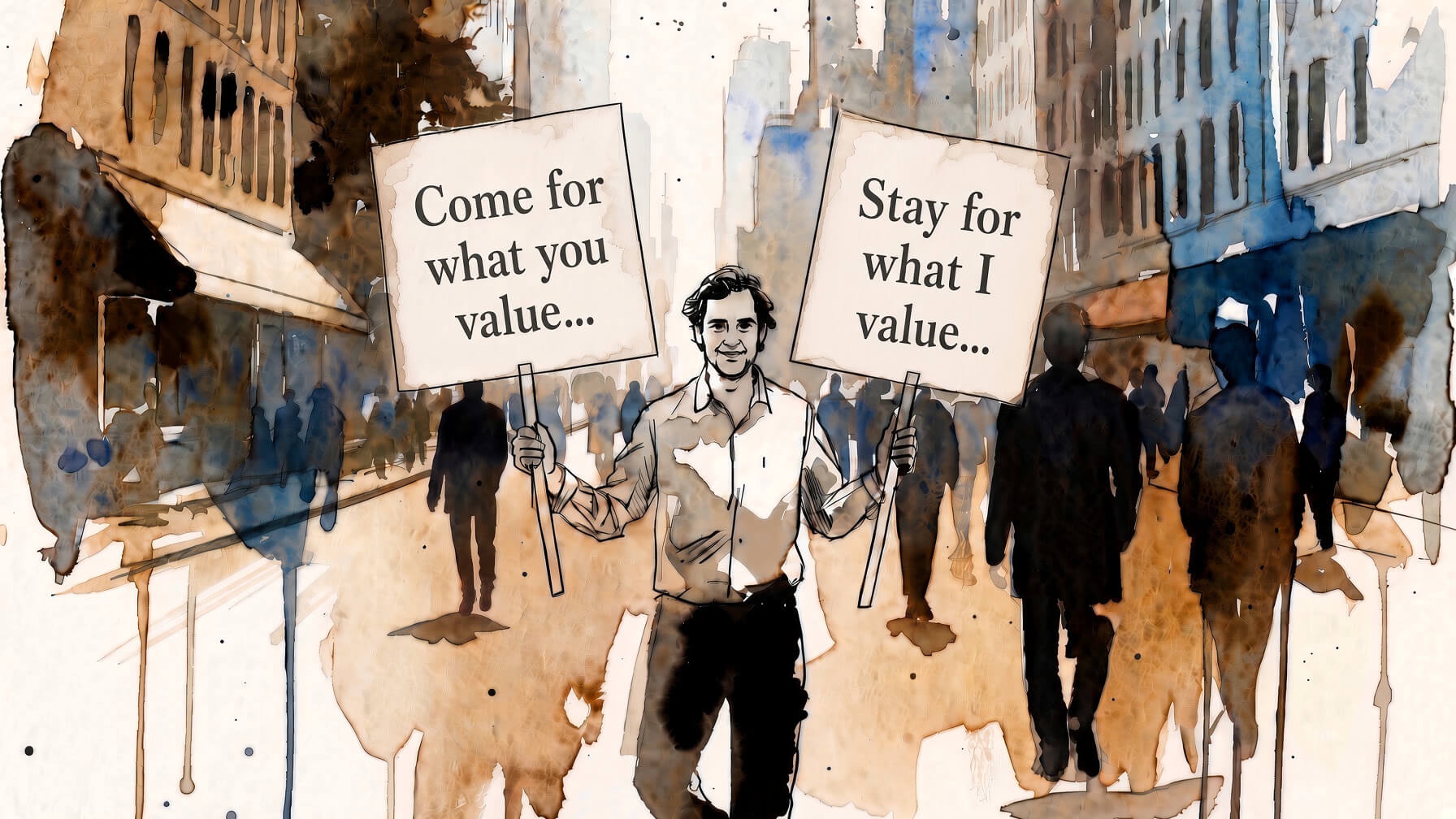
If you’ve ever felt pressured to speak up, felt guilty for not speaking out, or torn between your personal convictions and your professional responsibilities, this is for you.
Most advice aimed at Indie-experts gets this wrong in one of two ways: it treats your platform as a free-speech zone with no consequences, or it tells you to stay silent and pretend you have no convictions.
Neither of these works.
What actually works is drawing a clearer distinction between taking a stand as an expert and speaking up as a citizen. You are always both. The question is whether what you post serves the people who showed up for your work, or whether it serves the news cycle that just lit you up.
This article makes the case for keeping those two selves distinct, both culturally and in your own work; what authenticity actually means once you’re posting in public; a framework for deciding where speech belongs; the six rationales I hear most often from experts who want to speak up; and where speaking up actually moves the needle.
The Question I Fumbled
I was doing a workshop with a group of coaching professionals. While answering a question, I ventured into dicey territory when I said: “I wouldn’t recommend getting into political issues online.”
It’s one of those things you say as an aside, and then immediately regret because one sentence can’t possibly cover the ground several pages would.
I watched faces freeze on screen, wheels spinning. Some wondered if they’d broken some secret Facebook rule; others quickly raised their hands to object.
One man’s response in particular sticks with me. I could hear the tension in his voice as he carefully asked: “Are you saying we should never take a stand for what we believe in?”
With four minutes left in the session, I mumbled something about separating your personal feed from your professional feed, but I could tell he wasn’t satisfied with my answer. I wasn’t satisfied, either.
So, sir—if you’re reading this now—this is what I meant to say: The short answer is no; I’m not saying you should never take a stand.
The longer answer requires understanding why that question seems so hard to answer right now.
The Public and The Private
Separating the public from the private used to be accepted polite protocol. From it sprung phrases like “Never talk about politics or religion.” It was a practical rule of mixed company, meant to keep certain kinds of heat out of settings where people had not chosen one another for that purpose.
Both subjects mattered. Both also reliably produced argument rather than conversation. At a dinner table or a place of business, unsolicited debate carried a higher social cost.
The rule protected the people who had to share a space. It assumed that most gatherings were not assemblies of the already convinced, and that a stranger’s or a colleague’s convictions were not automatically your business.
Obviously, the public/private rule was never absolute. Families argued at dinner. Activists organized. Preachers preached. The protocol applied in public and semi-public settings where the relationship wasn’t built around those topics.
Most people point to two cultural shifts that gradually eroded the social wall between public and private: the end of the Hollywood studio system, and the birth of social media.
What The Social Wall Protected
The wall held as long as it did because fame required intermediaries — publicists, studio contracts, editors — who kept the unfiltered private self off the public stage.
Once performers appeared on live TV, unscripted, without their publicist, or published any hot take on social media, raw and unfiltered, 24/7, the old line between persona and opinion evaporated.
The current social landscape is a direct result of that collapse – minor stars and the regular people who copy them treat “speak your mind” as a job requirement. Add to that the feed’s appetite for hot takes, and you’ve got a never-ending firestorm.
Jennifer Lawrence famously said celebrities “do not make a difference whatsoever on who people vote for,” so posting “adds fuel to a fire that’s ripping the country apart.”
If that’s true for someone with her reach, the leap to a coach with 2,400 followers isn’t a big one. Which brings us to what your feed actually is, and what it costs every time you treat it like a soapbox.
Your Waiting Room
Think of your professional website and social feed like a specialist’s waiting room. People found you with a specific, expensive problem, and they’re scanning for one thing: evidence that you can solve it.
Every off-topic post spends a little of that focus capital — quietly, incrementally, never all at once. The reader who came looking for a specialist begins to wonder whether you actually are one.
The Disagreement Premium
Political content is even more expensive than it looks, because the perceived gains are noticeable, while the losses are invisible.
People who agree with you feel mild approval – “good, they get it.”
People who disagree experience it differently. They didn’t come to hear your politics or your take on the culture war. They came because you understand their knee pain, their retirement account, or their grief.
When you hand them something they didn’t ask for and don’t agree with, they don’t argue. They just decide you’re not quite the professional they thought you were.
The person who agrees likes your post and maybe leaves a comment. The person who disagrees closes the tab and doesn’t come back. No feedback, no notice – just gone.
The Invisible Exit
For a practice that runs on referrals, these add up. A former client decides not to recommend you to her colleague. A longtime reader skips your workshop. A potential patient who found you through a friend decides to call someone else instead.
None of these people announce themselves. You’ll never know their names.
But over time, they add up to revenue and relationships that never happened – easily outpacing the enthusiastic comments from the half that agreed.
The prospect who finds a political post runs the same quick calculation: will I get the same service if I don’t share this person’s views? That’s not cancel culture. That’s just how trust works when you’ve handed someone a reason to wonder about you.
For the indie-experts I work with, the audience is always politically mixed – they arrived for a particular kind of help, not a shared political project. When you treat them as the latter, they don’t argue. They just find someone who kept those two things separate.
Just Write Zuckerberg a Check
A chiropractor I know had been riding the Instagram wave for a year. He’d posted hyper-political videos, one of which racked up millions of views. I asked him whether those videos were on his personal page or his clinic page.
“My clinic page,” he said.
So I asked the next obvious question: had any of that traffic translated into new patients, or even any interest in his practice?
His answer was no.
A client emailed me a story that underscored the same point:
“I had a thread on X about a political figure that got 10 million views and 400 followers… but I haven’t sold anything. A few months later, my wife told me, ‘That’s great, but did we make any money?’ Lol.”
Here’s who did make money on that viral thread: X sold ads against those eyeballs during the spike. The platform piggybacked on his content. That’s their business model, not a side effect. They do it all day, every day, with yours too.
Cal Newport put it even more forcefully: “If you’re not making money from it, don’t post it. Otherwise, you might as well just write Zuckerberg a check.”
You can accept everything above and still feel the pull to wax political. The pull isn’t about ROI. It’s about identity. The feeling underneath isn’t “I want to change minds.” It’s “If I stay quiet, am I pretending to be someone I’m not?”
If I Don’t Post What I Actually Feel, Am I Being Inauthentic?
We’ve talked about the cultural story for why the social wall collapsed – and there’s also a personal one.
Both matter, because the rationale underneath most of this isn’t really political at all. It’s: “If I don’t post what I actually feel, am I being fake?”
You don’t have a single authentic self — you have several, and they’re all real. We’re more like a multi-faceted gem. The facet you show your college friends, the facet you show your in-laws, the facet you show a new client on a first call – each of those is an authentic facet of who you are.
Choosing which of these to lead with isn’t performance. It’s how functioning adults have always operated in mixed company.
Social media dissolved this by collapsing the private and public into one feed. And because most people post from home, alone, the unfiltered private self got recast as the most authentic one – as though stepping out your front door and being more intentional is somehow “faking it.”
The Authenticity Inversion
For this reason, the private self is often the least authentic version. In private, you’re unconstrained – the fearful you, the angry you, the doubtful you, led by whatever the lizard brain is doing that afternoon.
The public you, on the other hand, is more genuine, because it has to account for other people. It balances the lizard brain with the part of the brain that asks, “Is this actually worth doing or saying out loud?”
What social media mostly did, as Brian Clark put it, was let people “go right back to egocentrism” – focusing on themselves instead of the people they’re trying to reach.
The professional self isn’t a mask you wear over your real face. It’s the facet of you that has agreed to be useful to someone else for the duration of the relationship.
That’s not less authentic. It’s the most authentic version of you.
So when someone asks, “Are you saying I should hide who I am?” – the answer is clearly no.
The facets your audience knows are the ones that brought them to your door. Your audience’s trust is built on specific facets of your expertise and character, and that trust is an implicit contract.
Breaking that contract by broadcasting a different self isn’t more authentic. It’s a bait-and-switch on the people who showed up for what you actually offered them.
Then There’s The Stolen Pulpit Problem
Your audience didn’t subscribe to become your flock. They subscribed because something in your work recognized them. Using that recognition as leverage for a different campaign is a bait-and-switch, even when the campaign feels righteous. Especially when it feels righteous. Righteousness is what makes people skip the consent step.
On her podcast, Jessica Zweig captured this perfectly for coaches and spiritual teachers: “You don’t owe the internet of strangers your whole life in a glass case. Choosing what not to post can be as intentional as what you share. Channel the energy offline if you need to act.”
The best working model I’ve seen for avoiding it isn’t a theory.
It’s a person.
Dolly Parton and the Last Demilitarized Zone
With Dolly Parton’s death, this public/private issue was suddenly everywhere.
The Washington Post asked: “Was Dolly our last bipartisan icon?” Newsweek added, “Dolly Parton Was the Last American Everyone Could Love.”
The obituaries described her loss as the end of one of the last cultural “demilitarized zones” where people with opposing politics could still agree they liked what they found.
Think about what this says about our shared culture: we’re talking about the loss of one of the “last people” secure enough to meet people as people, without turning every encounter into a loyalty test.
Dolly practiced a version of that old-school public/private protocol. She never claimed to have zero opinions. She claimed the right not to hand them out like candy to every interviewer and every fan, because the people who liked her music had not agreed to become her constituency.
That was once considered ordinary professionalism. It has come to look like restraint only because the cultural expectation we all used to follow is dissolving.
Her Version of The Protocol
Dolly spent a career refusing the job of “spokesperson.” She explained she had as many Republican fans as Democrats, didn’t want to offend people she loved, and said she “had learned to keep her mouth shut if she wanted to keep working.”
Interviewers constantly tried to hand her a team jersey. She’d hand back a joke. Two presidents offered her the same medal; she declined both, so it wouldn’t look like she’d chosen a side.
After she died, both sides rushed to claim her anyway – which is exactly my point. Dolly kept refusing the polarizing interviews and causes people kept bringing to her door. She refused to let anyone borrow her credibility to win an argument.
The obituaries noticed. That refusal, they wrote, was part of why she was loved across the divide. Neutrality doesn’t stop either side from reaching for you. It just refuses to let either side borrow your name.
This is the part that matters for you: Dolly had a catalog of songs and a theme park to fall back on if even her neutrality cost her publicly. You don’t. For an indie-expert, you are the inventory. An off-purpose diversion devalues the asset you’re building.
A Framework For Experts’ Online Speech
The original question from that workshop — “are you saying never take a stand?” requires sorting three kinds of speech that often get conflated.
The speech and writing that holds up considers three things:
1. Domain speech – the expert talking about their expertise, including when policy touches that expertise. A doctor on a billing rule. A coach on platform terms. A health expert on meat vs. veganism. Some of these topics will land in someone’s political space. That doesn’t make them political posts. If the topic lives inside your domain, it’s part of the work.
2. Relational speech – how your posting choices honor or violate what your audience signed up for. Dolly’s version: “I love people. I won’t be used as a weapon against them.” Relational failure is conscripting an audience into a conversation they never agreed to have. Dolly refused to let either side borrow her credibility. That’s Relational positioning, not just good manners.
3. Factional speech – candidates, teams, the week’s outrage, the demand that everyone pick a side so the feed can sort them further into echo chambers.
Most of the rationales I hear accidentally collapse these categories.
So: back to the man in the workshop who asked whether I was saying he should never take a stand.
No. That’s not what I’m saying.
What I’m saying is that Domain, Relational, and Factional speech are three different things, and the feed collapses them into one. Most of the pressure you feel to post politically comes from the feed running that collapse on you in real time, with a notification attached.
The expert who talks about their domain — including when policy touches it — is not “staying silent.” The practitioner who declines to conscript their audience into a debate they didn’t sign up for is not cowardly. And the professional who keeps those two things separate from the week’s outrage is not pretending to have no convictions.
They’re just remembering the difference between the person their audience hired and the citizen they also happen to be.
Dolly knew both of those people. She just refused to let either one borrow the other’s podium. That’s worth more than it sounds, now that the podium is a phone anyone can pick up.
Part 2 of this series works through the seven rationales I hear most often from experts who’ve read all of that and still feel the pull to post — from “I need to change minds” to “I don’t care if people leave” — and what actually happens when people test them.


Leave a Reply