There’s something in the air these days – something hazy and unsettled, the way smoke lingers after a distant fire. And it’s affecting how most of the people I work with approach their writing. They tend to fall into one of three positions.
There are the experts who take one look at the day’s news and tell me, “With so much important, world-changing stuff going on, who’s going to read my stuff?”
Then there are the sensitive, empathetic souls who get so overwhelmed by the newsfeed that they freeze in indecision and doubt what to write and why it matters.
And finally, there are those who stay so locked-in and motivated by their expertise and audience that they write regardless of what’s happening in the world.
If you recognize yourself in one of the first two groups, this is for you.
A few years ago I was on a call with a group of practitioners that represented all three. It was during the height of what we’ll call the global health disruptions of the early 2020s. For months, clients had been calling in shock and anger as social media accounts were closed overnight and practices were shuttered for being “non-essential.”
Everyone felt suspended in deep uncertainty about what lay ahead, and it was this that brought us together – to encourage each other, brainstorm solutions, and regain a sense of purpose and direction.
That was the goal, anyway. I expected the anger and fear, but what surprised me was the emotion they expressed most often was helplessness.
As the call progressed, and one heart-breaking tragedy followed another, I was beginning to feel as overwhelmed as the rest of them. My throat tightened the way it does when words won’t come, and for a moment I was just another face in a Zoom box, quietly drowning along with them.
I had steered teams through thorny challenges before, but this time that red Zoom “Recording” dot glared at me like an accusation. Sixteen faces in sixteen little boxes, all intently focused on me, waiting for solutions I didn’t have.
I attempted to steer the conversation. “Angela, share with us a bit about what you’ve been doing for your team.”
Instead, Angela poured out the struggles of her now-laid-off team. I sat there silently, asking myself, what does this group need most right now?
No answer came. Someone’s dog barked in the background. A few participants were typing furiously in the chat, carrying on an entirely different conversation.
That’s when the memory arrived—along with the fresh, earthy scent of petrichor rising from a morning rain on the parking lot bordering my second-grade playground.
A Playground in the Middle of a Crisis
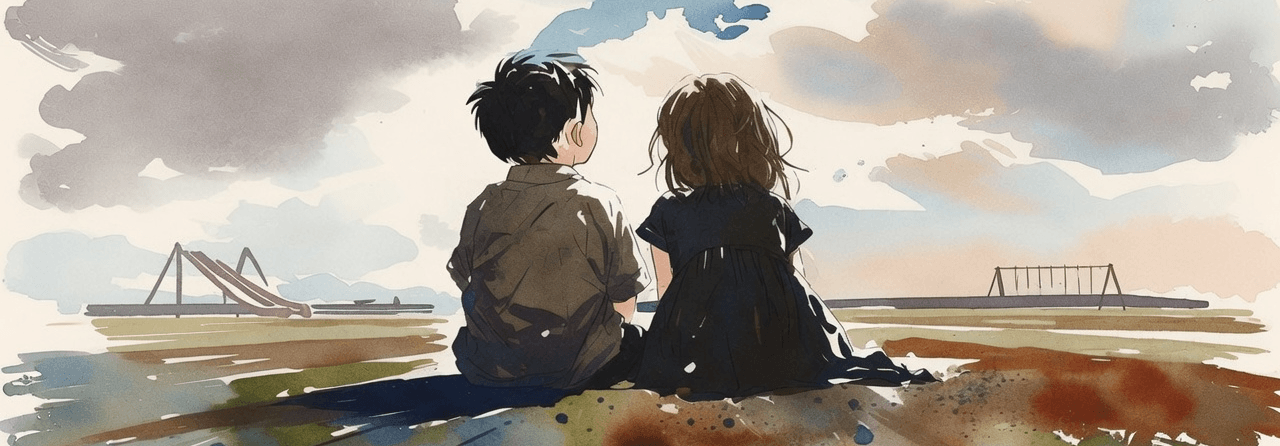
I’m six, sprawled out on that playground next to Zee, my best friend. We preferred to lie face-up on the loamy playground soil, eyes closed while our playmates swung high above us into a cloudless Southern California sky, or chased each other down a shimmering steel slide already too hot to touch by mid-day recess.
Some days, Zee would trace her fingers through the soft red earth while she softly and matter-of-factly told me the most horrifying stories of how the adults in her life hurt her.
Overwhelmed by emotion I didn’t yet understand and helpless to make her feel better, the only solution I could think of was to hug her. It didn’t feel sufficient, but it was all I knew.
I hugged Zee a lot that year.
The screen swam back into focus. Three seconds, maybe four, had passed in real time. But I suddenly felt grounded in a way I hadn’t since the call began.
“Actually… let’s pause there,” I said. “I just remembered something important.
“Think back to why you do this work in the first place – your personal purpose, the specific healing or truth or steadiness you’re here to offer others. And once you’re reconnected with that, ask yourself: What do your patients or clients need most from you right now?”
Their responses tripped over each other as we quickly compiled a long list of urgent client needs. “Now, what’s the smallest, most aligned thing you can do right now that honors that purpose?”
The energy shifted, and hope seeped back into the room. Not every problem had been solved, or every fear lifted. But those simple questions had given them somewhere to stand again. Later, several sent notes saying that session had pulled them back to their own work.
The Same Smoke, a Different Year
Maybe it’s just echoes of that global era we’d all like to put behind us, but since then, it feels like a lot of us have been carrying a heaviness that doesn’t belong to us.
I see traces of that same helpless feeling today in the faces of some of the people I work with. On group calls, I’ll sometimes watch a bright, engaged professional arrive as if the world’s weariness is sitting on her shoulders, already overwhelmed by that morning’s news in her Instagram feed. The latest wave of chaos has pulled her under. And I can tell we’ve lost her for now.
This sentiment especially came through in a recent message from an experienced therapist-coach I’m helping with her content. After describing the latest online turmoil and how it was shredding her ability to focus, she wrote:
“…I feel so stuck. With so much chaos and suffering in the world, how can I feel justified sharing my work? My writing just doesn’t feel significant enough to address the overwhelming pain I see around me.”
Yeah, this. Maybe you’ve had this thought too.
Many of the people I’ve worked with are highly attuned, deeply caring people- the very sensitivity that drew them towards this work in the first place. But in an age of wall-to-wall noise with constant guesses, half-truths, and 24/7 coverage of every distant fire – that same sensitivity can become a heavy burden.
When the feed is loud enough, attuned people don’t just notice the emergency; they internalize it. They carry a kind of ambient grief for situations they can’t touch, people they’ve never met, problems they cannot solve.
After a while, that weight starts to feel like their own.
The Flame You Were Called to Tend
Some of you have a fireplace at home – wood stacked on the porch, waiting on that first cold snap. That fireplace once centered family life. It was the gathering place, and sometimes the only heat source in the home.
Now picture your own steady flame. Not wood and brick – something less visible, but just as real. A flame that stands for your calling, your purpose, the contribution that’s uniquely yours to make.
The trouble is, these days it’s dangerously easy to lose sight of that flame. Smoke from distant fires keeps drifting across your vision.
The news and social feeds exist for one reason: to alarm us at every possible moment and keep us clicking on the next distant fire or human tragedy. They tug at you, hook you, enrage you, and pull you into arguing with strangers and bot farms while your real work waits.
That daily feed drifts in like smoke through a cracked window. Before you notice, your own flame—the steady, life-giving work you were called to do—sits untended. The clients and patients who need your clear presence, your undivided skill, and the work only you can do are right in front of you. They deserve a practitioner whose flame is protected and bright, not dimmed by smoke from fires you cannot reach.
The good news is you don’t have to choose between caring about the world and doing your own meaningful work. You can learn to notice the smoke, seal the cracks it slips through, clear the air when it thickens, and return—again and again—to tending your own flame.
Clearing the Air
A few simple practices have helped me when the air begins to thicken, and the first habit is the most obvious: anchor back to my own highest value, often.
If your primary task is to keep yourself from getting distracted from the flame you were called to tend, then anchoring each day by reminding yourself why you do what you do seems important. Reconnect to the original spark that led you to become a writer, coach, therapist, doctor, or healer in the first place.
After all, regardless of what else is happening in the world, people within your circle of influence still get sick. They still face uncertainty, pain, and confusion. People still need your specialty, your guidance, and your steady presence –especially when the rest of the world feels like it is spinning out of control.
In chaotic times, your focused attention on your own flame is not selfish; it is an act of responsibility and service. The smoke will try to pull you outward, but your obligation is to focus even more intently on the work only you can do right here, right now.
And I mean this literally: I watch good practitioners regularly disappear down smoke-filled black holes online, arguing about politicians or the latest amped-up event.
The people who need their grounded guidance never find them. The practitioner is still lost in the argument, and their feed has already moved on to the next battle. Meanwhile, the reader who needs them most just scrolled past.
Drawing Circles
Social media has blurred the line between what you can affect and what only has your attention. I’ve returned to Stephen Covey’s classic reframe more often since feeds took over our days.
His distinction still clears the smoke: the Circle of Concern is everything you care about or worry about. The Circle of Influence is what you can actually affect. Most of the fire in the feed belongs to the first circle. Your voice, your work, the next useful piece — that belongs to the second.
The newsfeed constantly expands your Circle of Concern, flooding you with distant fires that trigger empathy but offer no clear outlet. When helplessness rises, pause and ask: “Is this inside my Circle of Control or Influence today?”
It seems to me that this is a helpful way to name something in the moment it’s threatening to ensnare your attention, and with that pause between trigger and response, redirect that energy.
Once you’ve acknowledged your concern, then consciously return your energy to the smaller, brighter circle where your real impact lives – your patients, your clients, your next session, your next piece of writing.
This isn’t denial. It’s strategic stewardship. By keeping your focus where it belongs, you prevent the smoke from smothering your flame and do more good.
Protect What’s Yours to Tend
I’ve found that the smoke stops at the door when I’m intentional about notification-free blocks and protected physical spaces. It’s not about being a hermit; it’s about acknowledging that if I don’t guard my office (and my mind), the feed will inevitably take up residence there.
And when the room is already thick — when I’ve lost an hour to the scroll, and I can feel it rising in my chest, I step away from the screen. I go outside, take a short walk, look at something real and immediate. That’s usually enough to dissipate the haze and restore clarity.
The Way Back
I’ve watched this pattern for decades with brilliant healers and creators. The noise becomes deafening, the helplessness creeps in, and suddenly their own medicine feels too small.
The practitioners who find their way back always do the same thing: they stop trying to match the scale of the chaos, and they return to the work in front of them.
In the end, the smoke from distant fires will never fully disappear. The world will continue to burn in a thousand places, and the feed will keep carrying that haze into our days.
What changes is our relationship to it—and that shift makes all the difference.


Leave a Reply