
We go downtown to the village for dinner several times a month. We like sitting at the bar overlooking the lake because that’s where the most interesting conversations happen. They always start safe. Half an hour in, once the beer has loosened things up, people tell me things they’d never tell their best friend.
That’s where I met Abe.
He and his wife moved here from Connecticut. Retired, young and healthy, and very much refusing the label. Abe swims and golfs and corrects people when they call him retired. I asked him what he was doing to stay unretired. He looked down at his beer. “Well, I do a lot of reading…”
His wife Beverly cut in from over his shoulder: “He’s been writing a book. Tell him about your book, Abe.”
With a little coaxing, he opened up. He told me about managing large teams of engineers through rapid change, about the coaching initiatives he championed, about bringing a human element to a company that didn’t have one. He talked about why these things matter even more now, especially in the age of AI. His voice softened. “At least, that’s what I want to write about. I’ve mostly got notes so far.”
I offered him a few options for what to do with those notes. He sat up a little straighter and looked up from his beer for the first time in ten minutes. “I never even considered that,” he said.
I’ve sat across from dozens of Abes. They feel the pull to share, to create, to put something into the world, but they don’t know where to start, and the advice they find is built for a 28-year-old with a ring light and a TikTok account.
Abe bought an expensive “write your book in a weekend” course he found on Instagram. After the first session, he was overwhelmed and embarrassed. I told him the guy just wasn’t his teacher.
There’s nothing wrong with Abe. The problem is the default map being sold to anyone who wants to create.
The Map Was Never Made for You
That map was drawn for a different time and a different kind of mind. We are at an unusual inflection point. Focused, experienced, human thinking is becoming scarce. And you are sitting on a wealth of it.
Gen X has been here before because we vividly remember the dot-com boom and bust, when the usual suspects ran up feverish expectations of nirvana (or doom), only to crash into reality. Much like what we’re experiencing with AI right now.
When I see the 20- and 30-somethings in my feed breathlessly insisting that if I don’t learn whatever-the-latest-tool-is, I’m going to be left behind, I’m not fazed. Of course they believe that. This is the sea they swim in – all tech, all the time, everywhere they look.
My response is simple: balance the tech. Learn how to read paper books again. Figure out what you really think about things by writing in a journal and through long-form pieces online.
The Strengths You Bring to the Table
If you’re Gen X (or sitting somewhere on the line between Gen X and Boomer), this is the gift we’ve been given. We’re experiencing both sides of the divide. We know what to keep from years of reading and writing. We know what AI can usefully add. We also know the cost of overusing it.
Paul Jun summed up the practical reality well:
“I’ve noticed that if you can think well, AI becomes a multiplier. If you can’t, AI just amplifies your mistakes.
“The people who built strong foundational capabilities – who can read deeply, think critically, create originally – use these tools as extensions of their existing strength. They prompt with precision because they understand the underlying principles. They edit AI outputs because they recognize quality from their own hard-earned pattern library.
“The people who skipped the fundamentals become dependent on tools they don’t understand, producing work they can’t evaluate, making decisions based on outputs they can’t verify.”
The people Jun’s describing? They’re not the 25-year-olds using All The Tools. They’re 45, 55, 65, those with a hard-earned pattern library. The ones who built something real over decades, before the “shortcuts” existed.
The Myth That It’s Too Late
You open Instagram, and a 23-year-old confidently explains fragments of the work you’ve been doing for two decades. She has 10,000 followers.
You built a website in 2019 and have a newsletter with 400 people. And somewhere between that morning scroll and closing the app, you decide the window’s closed and the crowd’s moved on without you.
After decades of watching this play out, I know that belief is wrong, and it’s costing people the chance to do the most important work of their lives while they still have the energy and clarity to do it.
The Wisdom Gap
You’ve spent years working with people who couldn’t move forward. You listened to how those problems showed up in real life, not in theory, through actual conversation. You noticed what finally broke the pattern. Do that with hundreds of people over a few decades, and your insight and knowledge become wisdom.
A 23-year-old is still making those connections. What she hasn’t yet seen is at least as important as what she has. Her scaffolding is still going up. Yours is long done. That’s your real advantage.
But knowing you have something real to offer and actually sharing it are two different things. What many experts fear isn’t visibility. It’s being seen mid-transition—like they’re starting over at a stage when they’re supposed to have arrived.
I get it. That feeling is real. But it’s a misread of the situation.
Your story didn’t start late. Your story just started making sense. You can’t manufacture depth or shortcut wisdom. Younger people are working hard to build what you already have. The question isn’t whether you have something worth sharing. The question is whether you’ll share it.
Your Brain is Wired for This
Most people assume the brain peaks early and then declines. The evidence actually points the other direction. At 65, your brain is biologically better equipped for this work than it was at 35. The research on this is genuinely surprising.
Gene Cohen’s book The Mature Mind reframed a lot for me as I neared one of those pivotal birthdays. It turns out that normal aging often brings real neurological advantages.
The aging brain grows new neurons and dendrites – especially in the hippocampus. It strengthens connections and increasingly integrates both hemispheres, the analytical and the intuitive, in ways a younger brain simply can’t. The result is better judgment, greater emotional intelligence, and more nuanced creativity. Real wisdom, backed by biology.
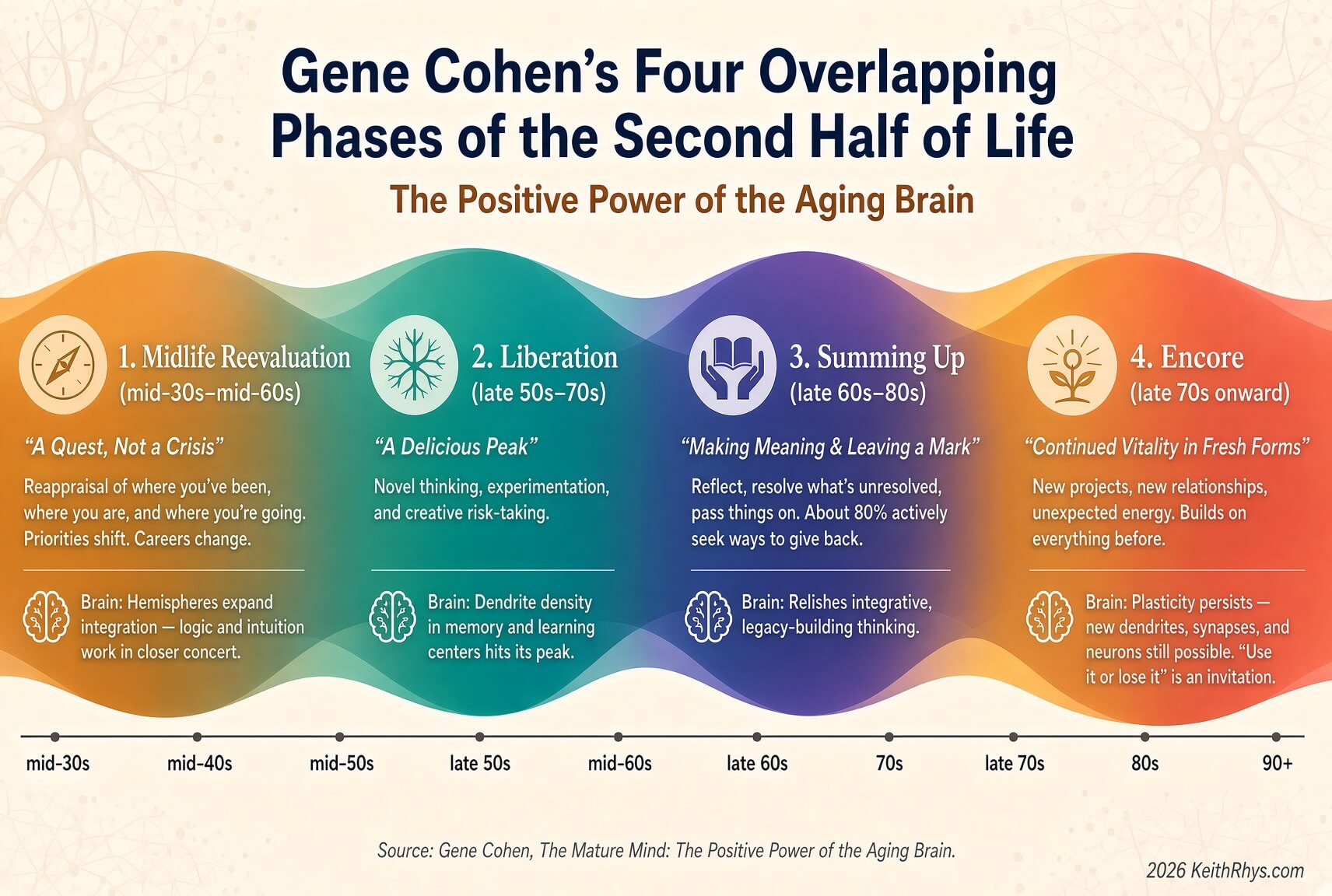
Cohen called this Developmental Intelligence, a wisdom quotient that deepens with age, and he mapped four phases of the second half of life that matter because you’ll recognize yourself in at least one.
The Four Phases of the Second Half
The first phase, Midlife Reevaluation, runs from your mid-30s to your mid-60s. It’s a long, honest conversation with yourself.
You begin asking: Where have I actually been? Where am I right now? And where do I want to go from here? Your priorities begin to shift, and you reexamine old assumptions. Your career changes, and you reconsider your relationships.
While all this is happening in your head, something is also happening in your brain. The left and right hemispheres start working together in ways they didn’t at 30. Logic and intuition start talking more directly, like two colleagues who’ve finally figured out how to stop working in separate rooms.
That restless, unsettled feeling many people hit in this phase isn’t them falling apart. It’s your brain reorganizing itself, building something more sophisticated than what was there before.
The Liberation phase follows, from the late 50s into the 70s, when dendrite density in key memory and learning centers hits its peak. Cohen described this period as “delicious.” The brain is primed for novel thinking, experimentation, and creative risk-taking. Not a transition to something quieter, but a peak
The Summing Up phase, from the late 60s through the 80s, is defined by a drive to reflect, pass things on, and make meaning. About 80% of people in this phase actively seek ways to give back, and Cohen’s research shows the brain genuinely relishes this kind of integrative, legacy-building thinking.
Then the drive shifts again—toward meaning and transmission.
Finally, the Encore phase, late 70s and beyond, brings continued vitality, new creativity, and often unexpected energy. Cohen found that plasticity persists well into this phase. With stimulation, the brain can still grow new dendrites, synapses, and neurons. Use it or lose it isn’t a warning; consider it an invitation.
Your instinct to share what you know isn’t sentimentality. It’s your brain telling you what it’s ready to do.
A Neurological Peak Meets a Cultural Opening
For decades, we’ve all lived in a culture built around youth. The images, the content, the platforms, the marketing – all of it aimed at and shaped by and for people in their 20s and 30s.
That era is burning down, in part because the economics and demographics are finally shifting – those 20- to 30-year-olds are now 50 and 60, and we’re in the middle of one of the largest generational transitions in modern U.S. history, sometimes called the “retirement tsunami” or “Peak 65” – and with it, the hunger for depth, context, and earned wisdom is becoming impossible to ignore.
Rob Henderson has written that older generations have become reluctant to claim the authority and wisdom they’ve earned, even as young people have a massive hunger for exactly that. “Part of the reason they behave so erratically,” he notes, “is to test where the line is, and to see what knowledge older people can share to steady their anxieties.”
Research backs this up. People who score highest on the traits associated with trustworthiness, responsibility, and genuine care for others tend to be older. A major study found that our mental, emotional, and intellectual functions peak much later than most people assume: around 60.
You’re not on the back end of something. You’re at a peak most people don’t know exists.
I see the generational distinction everywhere now. A recent SimilarWeb infographic made the rounds, tracking which AI apps had the largest share of users. They focused on ages 25-34 – the group with the highest use. Gen X sat near the bottom. Those 55 and older barely registered.
On one side, 20-somethings embracing a shortcut economy and rushing every act of creation to market. On the other, thoughtful 40- and 50-somethings saying, “Wait just a moment. Slow down. Let’s use AI to write better, not to replace the thinking.”
Gen Z and younger Millennials were raised reading on small screens, writing on screens, and now having screens write for them. Many of us were raised with books, libraries, manual research, and having to think and figure stuff out.
You see where this is going.
We Need More Wisdom Platforms
The experts who have the most impact aren’t the ones hoarding their knowledge in credentials and job titles. They’re the ones putting their thinking into the world. You don’t have to have it all figured out first. Share what you know where people can find you and give you feedback, and the work gets sharper as you go.
We need Wisdom Platforms: places built to transfer knowledge between people, not just to keep you scrolling.
That kind of transfer used to happen more naturally. Someone who’d learned something the hard way attracted the audience who needed to hear it, and someone who’d been through the fire would answer questions on a platform that allowed more room for exploration than a tweet.
That’s what you can build. And the world is hungrier for it than you think. The question is where you place your wisdom – a newsletter, a book built in public, articles on your own platform, a coaching framework, a YouTube series.
Build it Now
If you’ve been on the sidelines, I invite you to join us in pushing back against a bland shortcut future and embracing the richness and nuance human effort brings to the creative life. To use the habits you built in your youth to shape what comes next. And especially to resist the dopamine pull toward screen saturation and brain rot.
With the great flattening of the AI age — where bland, average content is now abundant, free, and instantly replaceable—you can’t spend five years figuring this out. Every day you spend convincing yourself the window has closed is a day you’re not building something that lasts. Every week you wait for the right moment is a week someone else, with less experience, less depth, and less earned wisdom, fills the space you should occupy.
This isn’t pressure. It’s just true.
Paul Jun was right: focused thought is becoming scarce. But that’s not a warning for you; it’s an opportunity. You spent decades building the pattern library. You have the depth, the judgment, and the stories.
Begin building your body of work now. Not when you have more time, not when you’ve figured out the format, not when you feel ready.
Your story has been making sense for years. It’s time to write it down.


Your writing is very up front and in the now moment easy to read and to go forward. Thanks once again.