Some days, I catch myself saying to no one, “I just need some peace and quiet so I can think.” The to-do list to prioritize and the demands to meet, with my nervous system dial turned up to ten. How do you keep focusing on what matters most when everything feels uncontrollable?
Turns out the answer was already in front of me – and it had whiskers.
Cat and Mouse, Meet Human
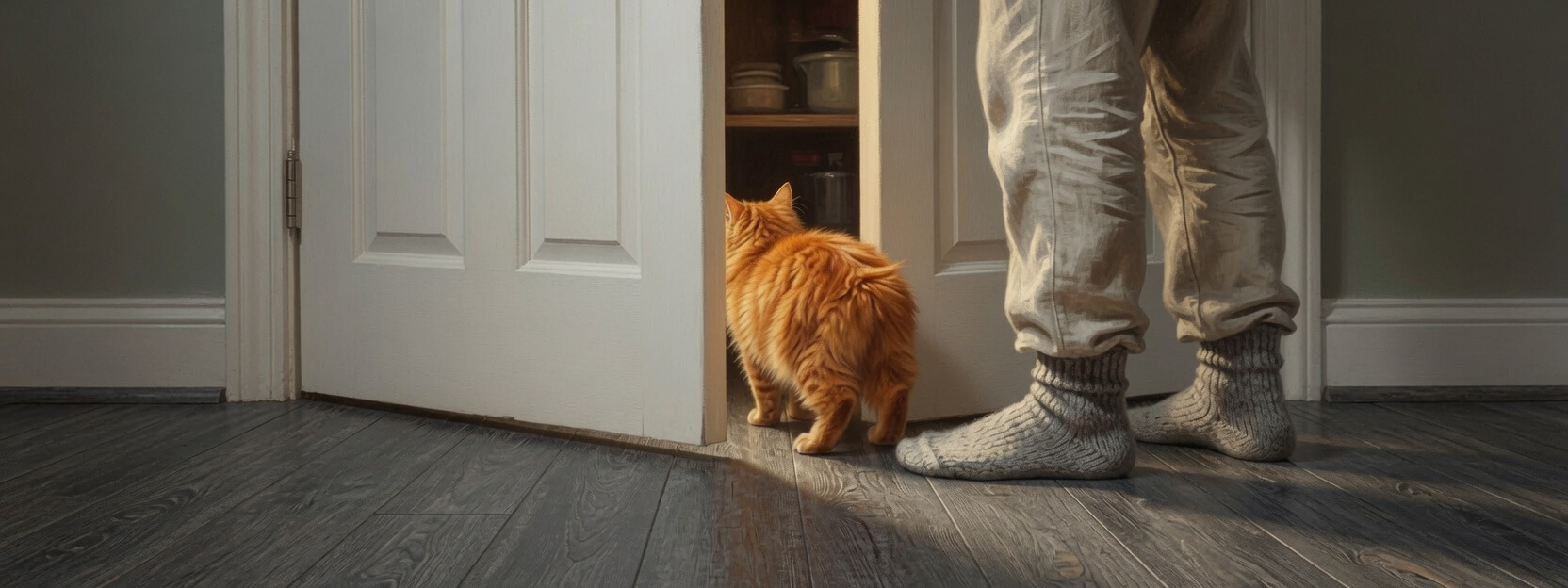
Consider Hudson, home-office cat #2. Hudson was a mouser. In his heyday, he’d hear mouse activity from across the room, rush to their suspected lair, and freeze – paws thrust under the refrigerator, whiskers vibrating at the scent of fresh mouse.
Hudson spent a great deal of time policing the pantry area. So I wasn’t surprised when, early one morning, as I approached the pantry to feed him, I heard the mouse through my pre-coffee haze.
Hudson’s mouse. Rustling, scurrying: tiny mouse feet with tiny mouse nails clicking across wood floors to an undisclosed mouse lair.
Hudson was locked in, staring up at me expectantly, and there’d be no breakfast – for either of us – until we dealt with the mouse. Groggily, I slowly opened the pantry door and flicked on the light, certain to catch said mouse in the act.
Nothing.
We poked about as the scurrying continued unabated. I checked behind every item on the bottom shelves, only to hear the mouse again – seemingly right beside me. Slowly I turned, the rustling following me.
I stopped. The mouse stopped.
Admitting my defeat, I stood and shrugged at Hudson – who had been eyeing me with great annoyance the entire time – and as I raised my arms, the mouse-like rustle rose to a crescendo.
I lifted my T-shirt and found a crisp wad of manufacturer tags, still attached, rustling against my waistband.
The mouse. In my shirt.
Dreams of Phantom Mice
The challenge begins with the device in our pocket: we hear a rustle, lift it to catch that message, video, or viral story, and we’re off, chasing phantom mice through the vast, endless pantry of the Internet.
Sometimes we look up and hours have passed.
These days, armies of electronic mice scurry through the airwaves from your phone, through your eye sockets, and into your brain cells, crowding out everything else.
Let’s say you’ve set aside time for creative work, or you’re with friends or family enjoying a meal. When you feel that phantom buzz from your pocket urging you to pull out your phone, how difficult is it to leave it alone?
Do you give in because it could be work? Get caught in the loop of checking just one more thing, pulled completely out of whatever actually mattered?
Have those “five minutes” on the phone ever turned out to be the fastest 45 minutes of your life?
The Phantom Emergency
We can become so convinced of the urgency of every trending topic that we invest real time, energy, and emotion in these digital mouse-hunts – only to find the source was a phantom.
I’ve been there. At one point, I was dreaming of checking my phone while I slept – anxiously scrolling in my sleep.
When I finally slowed down enough to observe my habits, the pattern was obvious: I was blocking the peace I sought. Music, videos, and podcasts piped through my earbuds while I did other things, what people call “multi-tasking.”
Most of the time, I wasn’t even listening. Just background noise.
Something had to change.
The Research that Changed My Mind
Of all generations, Boomers check or pick up their phones most frequently: 224 times per day (or 14 per hour). By comparison, the overall US average is 186 times per day, and while Gen Z picks up far fewer times (112 per day), they stay online the longest when they do.
Turns out I wasn’t alone in this, and plenty of researchers had already beaten me to the obvious conclusion. Heavy phone users report something contradictory: on one hand, they feel anxious, overstimulated, on high alert. On the other hand, real life starts to feel a bit dull and flat. Both make sense once you understand what’s happening.
Once stimulated, your attention needs time to settle. When you keep jumping from one thing to the next, your mind never fully arrives. Part of you is still back on that post or video you just saw.
Your Brain and Body Don’t Run on the Same Clock
The reason you might still carry that jolt from a disturbing video you saw fifteen minutes ago, even as your feelings are tangled up in a completely different story, is that your body and brain don’t shift gears at the same speed, and your conscious mind is trying to split itself between two things at once.
Once I named this mental static, I realized this is what I meant when I told myself, “I just need some peace and quiet so I can think.” I had eleven mental browser tabs open and kept re-reading the first line of each one. Every thought I started dissolved before I could catch the signal.
The reverse is also true: when you stay with something long enough for your attention to settle, your mind and body begin to sync. The experience grows richer and more alive the longer you focus on it.
Researchers have names for what happens in our brains.
Residue and Resumption: The Near-Term Costs of Switching
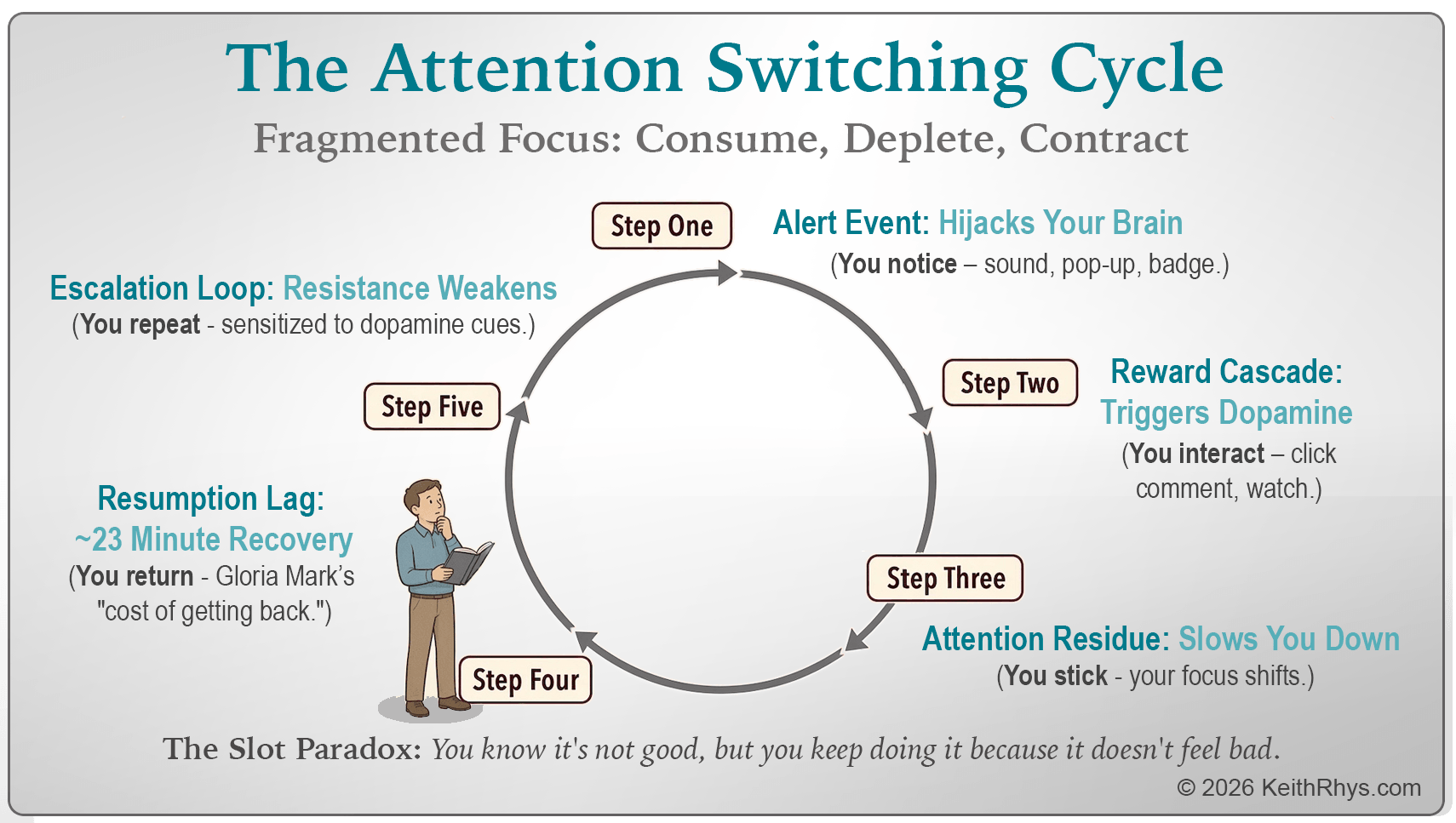
Researcher Sophie Leroy found that when you switch from an unfinished Task A to Task B, cognitive activity about Task A persists – creating what she calls “attention residue.” This impairs your focus on what’s in front of you. The effect is stronger under time pressure and worse when the first task lacks closure.
Gloria Mark spent years tracking how people actually work, and she found that returning to genuine focus after a single interruption takes an average of 23 minutes and 15 seconds.
Some of that time is practical: finding your place again and picking up where your thinking left off. Some of it is just the mental hangover from the interruption itself.
Brief switches, whether external interruptions or quick checks like answering a text, fragment focus, extend recovery time, and amplify stress.
Deep Work Doesn’t Stand a Chance
With these immediate cause-and-effect loops identified, what are the long-term compounding effects we keep hearing so much about? You know the ones: we’ve all become so hopelessly glued to our screens, we’re losing the ability to think, let alone focus.
We’ve seen the stats: Gloria Mark’s research shows a downward trajectory: in 2004, people sustained focus on a task for about two and a half minutes before switching. By 2016, that number had dropped to 47 seconds.
It’s been a decade since then. Dare we ask where we are now?
The Slot Paradox
Much of what we’ve been discussing- the irresistible pull of the device and the soma-like ease of slipping into a doom-scrolling haze- shares a common mechanism: what I’ll call the Slot Paradox.
We know the platforms that fragment our attention do so deliberately. Notifications, infinite scroll, and variable rewards are the same mechanics used in slot machines – and they’re engineered to keep us hooked for ad revenue.
If you’ve ever been to a casino, you’ve seen the Slot Paradox in action: every person there knows the house always wins in the end, and they know on some level the machines have been designed to addict them, yet they keep showing up and paying to play.
We recognize the game, yet we still sit down at the machine. We know our phones have addictive features built in, and the price we pay is our attention.
But Is That Cost Really So High?
After all, most of the time we’re reaching for the phone in harmless-looking moments – standing in line at the grocery store, or when an unwelcome thought or feeling pops up that we’d rather not deal with. The habit is so seamlessly woven into our days that we rarely pause to notice those small attention withdrawals quietly adding up, or what they replace: a great idea that was just beginning to form, only to dissolve the instant the screen pulls us in.
So what do we do? Increasingly, we’re being offered three solutions:
- Long “Digital Detoxes” to reset.
- Retreat to a cabin in the woods, abandon all tech.
- Regulate our way to safer devices, as if that’s really possible.
Devices Aren’t the Whole Story
To complicate things, here’s what else we know: those devices have upsides, too. They can deliver trash or Shakespeare. And it turns out some people are perfectly capable of focusing around screens: Someone who can’t finish a novel might be riveted by a 2-hour history documentary. This shows different cognition, not inferior cognition.
In other words, we’re missing the point when we focus so intently on the device itself. As the old proverb goes, a bad workman always blames his tools. We’ve collectively accepted the status quo and temporarily forgotten that we still have a choice.
While I’d love that cabin in the woods (lakefront, please), I prefer a third path: awareness and choice.
It seems to me our solutions really come down to awareness of the environments we consume in, and which choices build and which destroy. Awareness seems key – because once you see the Slot Paradox clearly, you can start playing it differently, with intention.
Here’s How Awareness Becomes Action
Which environments, tools, and apps steal your attention, and which ones actually support it?
- Starting the day with your device can lower your “overall well-being.” Many people report feeling calmer and more in control when they delay phone use for the first hour of the day.
- TikTok is engineered for endless short-form dopamine loops. Use it less.
- A Kindle in airplane mode with notifications off is built for sustained reading. Use it more.
- A physical book in a quiet room with your phone in another part of the house? Even better.
- Mix digital with analog: Watch documentaries with a notebook nearby, or listen to podcasts on a walk so your mind can wander – record any thoughts that come up.
Dopamine and the Digital Detox
In some circles, digital detoxes are all the rage. I know people who lock their phones away, sometimes for months, only to return and be sucked right back into the digital vortex within days. My first digital detox was doomed from the start – and phones weren’t half as addictive as they are now.
Other than moving to the woods, I thought there had to be a better way than total avoidance.
To intentionally reclaim calm focus and mental bandwidth (and my sanity), I ran some experiments. I started by pulling threads from various approaches and theories, paying attention to what changed.
My First Attempt to Change My Relationship With Devices
First, I had to change how I was using the device. Not get rid of it. Just stop letting it run the show.
- I don’t start the day by opening my phone: no phone until after the morning focus session.
- I don’t end the day with my phone. Off at sunset.
- No more podcasts or videos through earbuds during focus or work hours. Reserved for non-brain activity only (doing the dishes counts).
- Deleted all social media and email apps from my phone. Scheduled twice-daily checks on my desktop, timed, between focus sessions only.
Here’s what the first round of experiments taught me, a useful stepping stone to the deeper discovery that came later. Some results were nearly instant. Others compounded over time:
- The peace and quiet I’d been chasing was always waiting for me in my own head. Without the constant competition for focus, I felt less scattered and felt more creative and excited about my work.
- Generalized anxiety about things I couldn’t control began to lift. I felt more in control – and dare I say, hopeful.
- FOMO faded. I still read the 3–4 writers I trust in five minutes on my desktop instead of spending hours doomscrolling.
These measures have helped. And I follow most of them, most of the time.
The Good News: You Don’t Have a Willpower Problem…
Since that last attempt and the full digital detoxes that preceded it, I’ve talked with dozens of people about their experiences. The common theme? Detoxes just don’t stick. For me, all it took was one low-energy, aimless day, and I’d pick up the phone and go back down the digital black hole I went down.
The detoxes and tricks work for a while, to a degree. Researchers have an explanation for that too: it’s how we’re wired. Deep in the brain sits an ancient system called the basal ganglia. This is the same system that still runs our dopamine reward signals today.
The moment a dopamine spike fires, your brain stamps that experience with a single instruction: save this one. Sometimes for months, long after the actual reward stopped showing up.
Your hippocampus files the exact sequence you used, too: tap here, scroll here, pause here: this is where that flood of chemicals arrived. The brain keeps those old dopamine hits on file, just in case they might help you survive later. (Never know when you’re gonna need that cat video…)
In other words, the dopamine reward system works a lot like riding a bike. Once you learn it, you never really forget. That explains the lagging effects of detoxes.
But it explains something else, too – why trying harder doesn’t work either.
The Try Harder Paradox
When you “try harder” to put your phone down, you’re calling on the same part of you that remembers to defrost something for dinner, the part of your brain that needs sleep to function.
The urge to reach for the phone isn’t located there. It lives in something called the nucleus accumbens, and that’s the part that yanked your hand off a hot burner before the pain signal even arrived. You didn’t think about it; your arm just moved.
That’s the part of your brain you’re trying to talk out of something.
In the 1950s, two researchers, Olds and Milner, ran wires directly into rats’ brains, specifically that same small cluster of cells that fires when your phone buzzes with a notification.
They pressed a lever, and the rats got a jolt of pleasure straight to that spot. The rats stopped eating or drinking water. They ignored other rats. They pressed the lever until they died – choosing that jolt over everything else life had to offer.
What matters most here is this: the stimulation wasn’t producing pleasure. It produced wanting, an unresolvable anticipation with no possible satisfaction, no “enough.”
Sound familiar?
Dr. Andrew Huberman and others put the failure rate for willpower-based digital detox at well above 70%. You can’t out-discipline your neurochemistry; you have to address it differently. That starts with understanding what’s actually driving it.
It’s Not the Dopamine — It’s the Training
There’s a growing body of thinking – part neuroscience, part practical addiction research – that says the problem isn’t dopamine itself. The problem is how we’ve trained our brains to expect it.
You sit down to reread a book you love. A few pages in, you slam it shut. Nothing’s wrong with the book; you just can’t focus on it.
Your hands keep drifting toward the phone. Not because there’s anything there – you just checked – but because months of fast, unpredictable hits do that to you. The ordinary moments you used to enjoy now feel flat when compared to the device.
While my experiments in changing my relationship to my device helped more than a full detox, they still focused on putting constraints on my use. That helped me control my use better, but it didn’t change the desire or reward mechanism itself.
Although more balanced constraints were better than a full detox, they still only addressed the surface, not the root.
Cat and Mouse, Meet Rat
In the late 1970s, psychologist Bruce Alexander ran a series of experiments known as Rat Park. Researchers had already shown that rats kept alone in tiny metal cages would drink morphine-laced water almost nonstop – sometimes to the point of overdose.
Alexander’s real question was simpler: what if the rats kept drinking morphine water because there was nothing else to do?
So he built them a real rat community with lots of room to move around, things to explore, and other rats to play with. Then he put the bottles back.
The rats in the park largely ignored the drug. Even those already dependent preferred plain water once they had a richer life available.
The isolated rats kept going back to the bottle.
The lesson wasn’t that morphine is harmless. It was that an impoverished environment makes the chemical far more compelling. Give the animal something better to live for, and the pull weakens.
Our phones function a bit like those tiny metal cages. They offer a narrow, high-intensity reward in a life that often feels low on real connection, mastery, or physical engagement.
Don’t Starve the Dopamine System, Feed it Differently
When you replace low-effort digital hits with activities that still activate the same circuits, but through effort, the brain begins to reweight what feels worth seeking.
Take a long walk, do something with your hands. Have a conversation that lasts longer than you expected and goes somewhere you didn’t plan for.
None of those things give you the sharp little spike you get from a notification – but they leave something behind that the notification doesn’t. And because they usually require something from us, the reward sticks.
Writers like Anna Lembke describe it as restoring the pleasure-pain balance. Spend enough months opening Instagram every time you feel restless, and the neurons that fire together wire together around that loop. Scrolling becomes what your brain registers as a reward.
That’s when you sit down to read an actual book, or have a conversation that goes somewhere, and it feels flat within minutes.
Start putting the harder “analog” things back in, and the brain slowly restructures. But the pathway to the effortful thing deepens. Put the phone down long enough, consistently enough, and it stops feeling like deprivation. The pull just becomes less interesting than whatever else is happening.
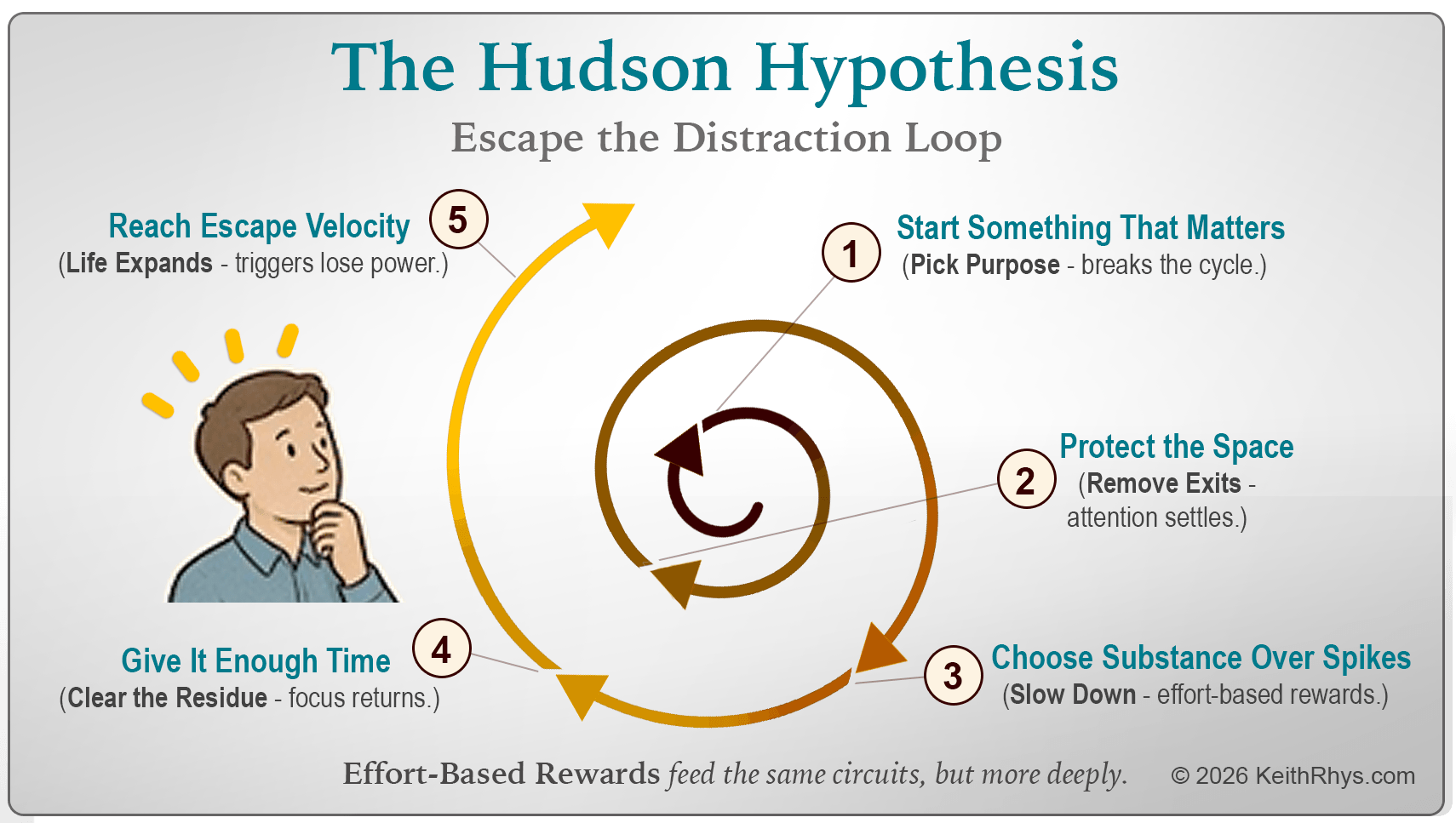
This is the Full Focus life: we create and build, and life expands rather than contracts. You switch from the constant effort of fighting distraction to expanding into the draw of full engagement.
The Hudson Hypothesis
Imagine one day, an hour into a project that has your full attention, you look up, and the phone is still face-down on the desk. You didn’t give in to the urge to check it. You didn’t even feel the urge.
That state, one where you’ve escaped the distraction loop entirely, is what I’m calling the Hudson Hypothesis, named after my furry office buddy – because, why not?
I stumbled onto this missing piece entirely by accident.
I was thinking about those periods in my life when I’ve felt most “locked-in” to life, work, and creativity. I created my most enduring work during those periods. What were the common themes?
During those times when I felt most “on purpose”, when I had something I was working on I couldn’t wait to return to, I completely forgot about whatever was giving me those shallow but addictive dopamine rewards. The phone became a nuisance, an aluminum paperweight.
Suddenly, I had something I wanted to do more of. No five-step detox. No sweating it out trying not to pick up the phone during dinner. When I feel locked in, even while doing other things, my mind craves that expansive state, which is far more rewarding than the best video on Instagram ever was.
The Science That Explains Why The Hudson Hypothesis Works
What I was missing in my last attempt is something Anna Lembke describes in her book Dopamine Nation. Lembke describes a seesaw: every intense pleasure is followed by a compensatory “pain” or deficit. Constant easy digital rewards tip the scale toward deficit, which is why ordinary life feels flat.
The remedy is temporary abstinence from the high-intensity stimulus – which, for me, my experiments addressed. This is where most people stop.
At the same time, we also need to deliberately engage with natural, “analog,” often effortful rewards: exercise, face-to-face interaction, creative work, time in nature. These activities produce more moderate, sustainable dopamine responses and help recalibrate the system so everyday rewards regain value.
That is the Hudson Hypothesis in practice: not white-knuckling your way away from the phone, but giving your brain something better to reach for.
Hudson Had It Right All Along
I started this article saying I just needed some peace and quiet so I could think.
Turns out Hudson had already figured it out. It only took once: he never fell for an imposter mouse again. Every day he showed me the same discipline: while the humans around him created chaos and cacophony, he sat and watched us with a calm, patient, unperturbed stare.
Hudson waited. And when the real signal finally arrived, he was ready to pounce.
You already know the parallel. Not every digital rustle needs investigating, and not every trending hashtag deserves your attention. The peace, quiet, and focus you’ve been looking for were never waiting in the feed. It lives in the moments you choose what else gets your attention.
Every single time you make that choice, you reclaim a little more of yourself.


Leave a Reply