I’ve lost count of how many times a client has asked me some version of, “Should I get another degree?”
It’s never the same as asking about adding a new technique or protocol to the professional toolbox. We’re all for lifelong learning—in fact, that’s what this article is about.
This particular question almost always comes from the best-educated, hardest-working researchers and clinical specialists in their fields. And the doubt underneath it is always the same: they still don’t feel they know quite enough to put their expertise out into the world.
These are people who have spent decades hands-on acquiring a one-of-a-kind set of knowledge, skills, and experience that no one else can duplicate. In a world overflowing with AI-generated content and self-appointed online gurus, that kind of depth is becoming rarer—and more valuable—by the day.
What surprises most of them is that the doubt itself is one of the strongest signals they’re the real thing.
Mistaking the Map for the Territory
You’re probably familiar with Cornell psychologists David Dunning and Justin Kruger and their famous 1999 paper. The short version: unskilled people massively overestimate how good they are, while highly skilled people tend to slightly underestimate themselves.
Scientists still debate exactly how strong the Dunning-Kruger Effect is and what causes it. Some say it’s mainly poor self-awareness; others argue it is partly a normal statistical artifact.
But the core finding holds: the least competent people are often the most confident. The more you don’t know, the less likely you are to realize it. The research has been so widely cited that graphics like the one I recreated here have sprung up everywhere, dramatically exaggerating what was actually a more subtle, linear pattern in the original paper.
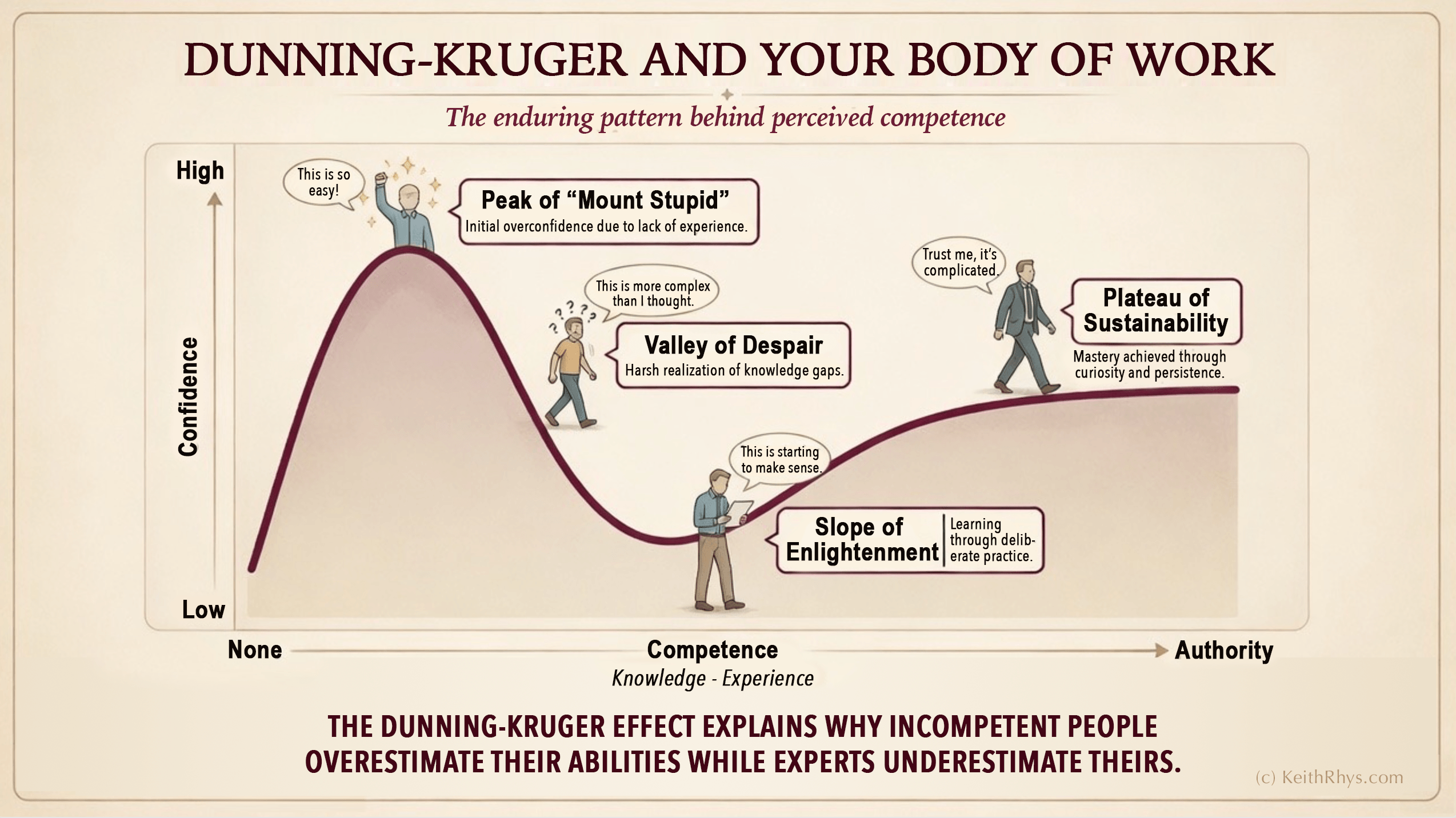
The graphic depicts a pattern we see constantly online: some guy watches a few YouTube videos, proclaims himself an expert, and starts teaching others. He’s learned just enough to be dangerous and has absolutely no idea what he’s missing. What once seemed complex now seems simple, a classic case of mistaking the map for the territory.
This is what some call the “Peak of Mount Stupid.” He’s there because he hasn’t yet encountered enough complexity to realize what he doesn’t know. It’s an easy mistake to make, especially with influencers actively coaching people not yet out of high school to “teach others what you’re learning.” This is how we end up with 16-year-olds with a racing metabolism and zero body fat lecturing the rest of us on how to lose weight.
And why not? If they want to be part of the online conversation and feel useful, what else are they going to write about? That beginner’s excitement can feel invigorating at first – until they realize it’s all they’ve got. For the legitimate experts running into this online, it’s more than frustrating. I hear this constantly from clients.
This is the model that runs a lot of the internet – and AI has turned out to be a near-perfect laboratory demonstration of the Dunning-Kruger effect in action. The chatbots most people are using have been trained on social media and places like Reddit. Type in a simple question and you’re essentially getting an average of the lowest common denominator of knowledge on Facebook and Reddit, posted from the peak of Mount Stupid. (Go deeper with more complex prompts, and you’ll start finding the good stuff. But I digress.)
Where The Map Gets Complicated
For those who stay curious and keep going, the terrain shifts under their feet. They start seeing the complexity they’d overlooked. Exceptions to their once-certain knowledge start multiplying, and their confidence hits a new low.
This is the Valley of Despair, and this is where genuine expertise begins.
You’ll know these people by how they talk. They use phrases like “it depends on…” and “let’s verify that.” If they sound uncertain, it’s only because they finally see the full map – and realize how much of it is still left to explore.
Many of the health and wealth influencers you encounter online never get here. Unaware they’re standing atop Mount Stupid, they launch products and businesses built on viral TikTok trends. They’ve watched three videos on content marketing and jump online to show people how to “10X your Wellness Instagram.”
Those who reach the Valley of Despair now see the path more clearly. They keep moving, stay curious, explore new avenues, and learn new rules. Eventually they travel the Slope of Enlightenment toward the Plateau of Sustainability – where true expertise and competence actually live.
These are the Indie-Experts building their Body of Work: the ones who’ve lived through the Valley, tested their knowledge against real-world complexity, and learned through direct experience. That combination is invaluable.
The Two Kinds of Doubt
It’s important here to make a distinction: The doubt we’re talking about isn’t “am I smart enough?” or “am I worthy enough to put myself out there?” Those are different questions entirely, and ones worth examining on their own. This is something more specific: Do I know enough to speak authoritatively on this subject?
This question is counterintuitive, and it never fully goes away. Not with more study, not with more credentials, and not with more years in the field. And it shouldn’t. Real expertise doesn’t arrive at “I’ve figured it all out.” It arrives at “I know this terrain well enough to navigate it – and well enough to know exactly where it gets complicated.”
Here’s the way renowned physicist Richard Feynman put it: “I don’t feel frightened by not knowing things. I can live with doubt and uncertainty and not knowing. I think it’s much more interesting to live not knowing than to have answers which might be wrong. I have approximate answers and possible beliefs and different degrees of certainty about different things, but I’m not absolutely sure of anything.”
The more you actually know about a subject, the more clearly you can see the edges of what you don’t yet know. That’s not a weakness. That’s precision. And that precision is precisely what makes your perspective worth something.
This isn’t necessarily an age thing, though years invested do tend to accumulate. What matters is whether you’ve stayed curious long enough to encounter real complexity – and whether that complexity has humbled you. If it has, you’re already in exactly the right place.
Where Your Leverage Is
The Peak of Mount Stupid is really crowded. Confident generalists with a surface-level take on every trending topic are everywhere. Fortunately, even though they’re often the loudest online, they’re not your competition.
What’s rare is someone who has actually made the journey down the other side, because that’s where the real leverage is – and it’s what the Expert-Authority Pyramid makes visible.
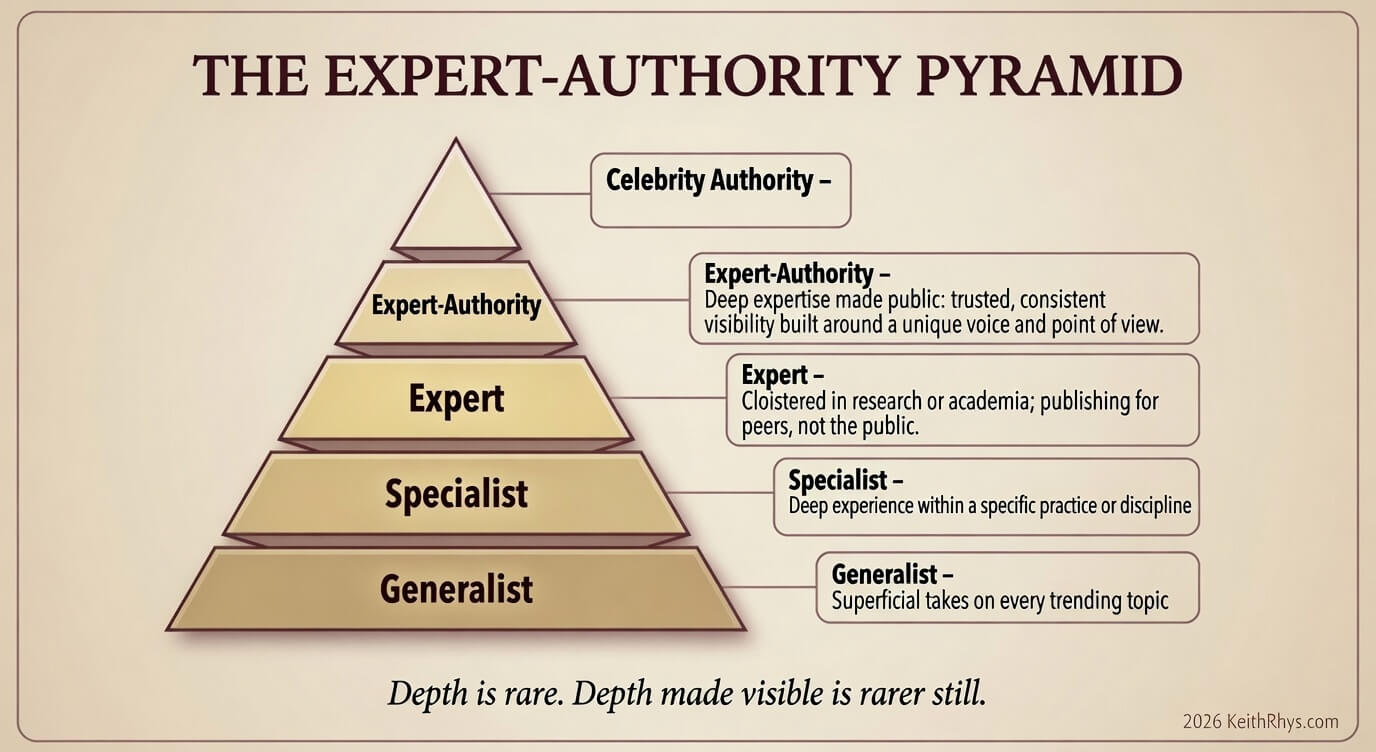
This framework shows exactly where the leverage point is for most of the professionals I work with.
Starting from the bottom:
- Generalists are content to write about whatever they’re into at the moment, always chasing the next trend to hop on.
- Specialists are where most of the doctors and coaches who reach out to me already live. They have decades of clinical or professional experience and typically contact me when they want to extend their reach from a local practice or clinic to a broader online audience.
- Experts are typically cloistered in academia or research, working within their own circles and publishing primarily for other experts.
- Expert-Authorities are what we aim for: the difference between Expert and Expert-Authority is visibility and trust. And I’m not just talking about attention—which is easy to attract and quick to lose—but about sustained, focused, intentional visibility built on a unique expertise stack, voice, and point of view. Authority isn’t something you claim; it’s assigned by the audience that comes to count on you for a specific topic or perspective.
- Celebrity Authorities are a completely different article.
If you’re like most of my clients, you’ve already done the serious work: years of study, research, and hands-on experience that puts you solidly in the Specialist or Expert tier. As we’ve seen, most of the people crowding your space online aren’t your real competition – they’re stuck at level one. They larp at expertise, but the facade falls away quickly under any real scrutiny.
The professionals I work with can build a deep body of work because they’ve been through the Valley of Despair, often more than once. They’ve questioned their own assumptions, tested their knowledge against reality, and come out the other side with something that can’t be faked or generated by a chatbot with a Reddit education.
That gives us a deep and rich vein of gold to mine – and the foundation to build a legacy-level body of work.


Leave a Reply