
Have you ever had one of those dreams where you show up somewhere and realize you’re only wearing your underwear?
Roughly 60 percent of us specifically recall the “failing or being unprepared for an exam” dream. Different scenarios, same underlying anxiety: I’m about to be fully visible, and I’m afraid what’s under the surface isn’t ready to be seen.
Many years ago, I lived that dream in real time.
One Night in the Spotlight
In college, a group of friends talked me into going to a local comedy club to see Joan Rivers. I knew her vaguely from late-night TV. The room was intimate—small round tables fanned out from the stage—and we were ushered to a table front-row, stage right.
The lights went down, and there she was. During one of her monologues, I drifted, staring up at her face, wondering if anyone else noticed the thick white stage makeup spackled on as if applied with a putty knife. Didn’t her people know she was performing in a small room, and that those of us in the front row could see exactly where the plaster stopped at her neckline?
Apparently I was staring in a uniquely loud way. Rivers stopped and asked me what I was looking at. Then she grilled me, listing every possible thing she imagined a young man might be staring at. (I won’t go into the details. If you know her brand of humor, you can fill them in.)
The audience found it uproarious. Meanwhile, a blinding spotlight had locked onto our table. Wide-eyed and startled, and desperate to keep any shred of anonymous safety, I muttered a few deflections.
That only made her sharper.
“What’s your name?”
“Ummm, Keith.”
“Well, Keith, why don’t you come on up here and join me.” A stagehand appeared with a stool.
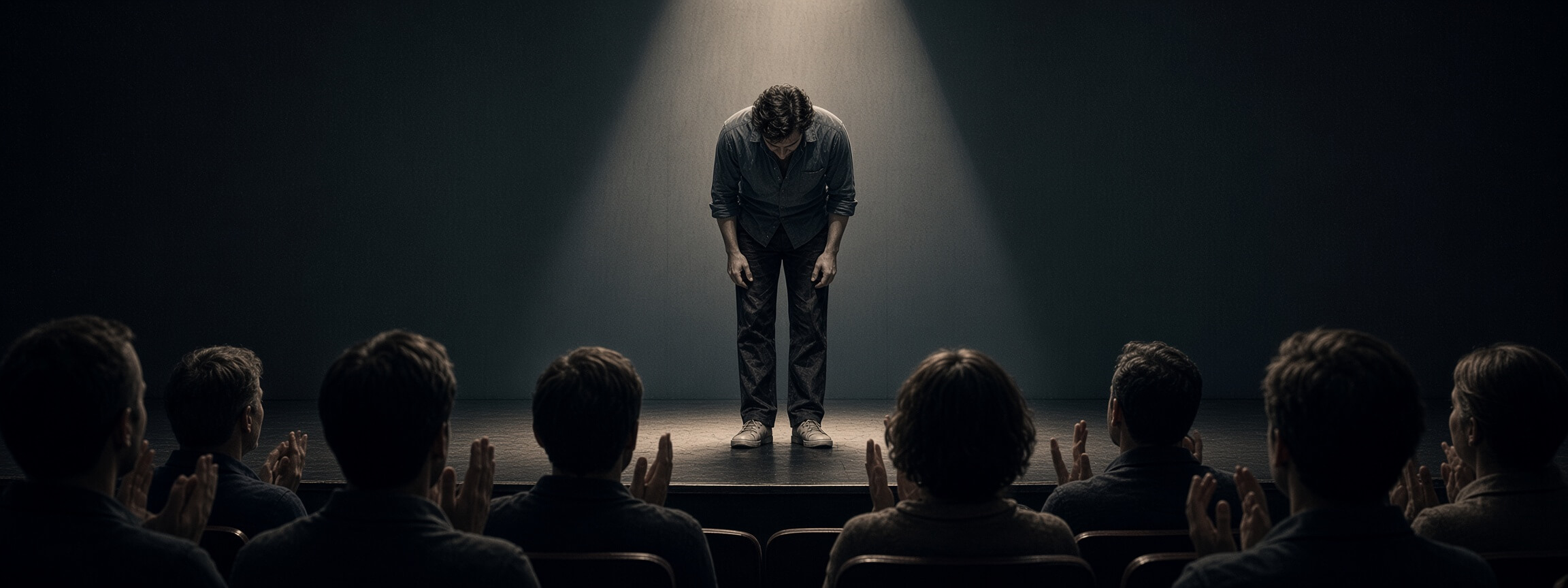
Once I was seated under that white-hot light, Joan turned to the crowd: “Now let’s all stare at Keith.” Gales of laughter.
Those ten seconds felt like hours. I went from audience member to main attraction with no warning or preparation.
A couple of lessons from that night: your mom was right—don’t stare; it’s rude. And never accept front-row seats at a comedy club unless you’re in the mood to become the night’s target.
I laughed it off with my friends afterward, and for years, it made for a great story.
Only later did I recognize that feeling for what it was. There’s a faint sense of being seen before you decided you were ready to be seen. Like one of those dreams I opened with: the spotlight swinging your direction before you’ve had a chance to get ready.
That specific feeling of being seen before you’re ready shows up with almost every expert I work with, right when a new opportunity aims a spotlight at them and the theoretical becomes real.
The Spotlight You’re Actually Afraid Of
One day, a call comes with an offer to propel your work onto a bigger stage. Do you tense up? Do you immediately start calculating whether you’re ready?
That calculation is the problem: You’re running today’s version of yourself against a future moment – and of course that version comes up short. It’s supposed to.
The work is to build now so that when that moment arrives, you walk into it already competent and relatively at ease.
My Rivers experience came from a front-row ticket and a distracted look. It had nothing to do with readiness or desire. That is precisely what most people fear: being yanked into the spotlight with no idea what to do, being seen before you’re ready.
Authority shows up differently, like the client who spent two years writing a weekly article for his site that only a few people read. A national magazine editor found one of those articles through a search, reached out, and offered her an assignment. That single article led to a book deal with a major publisher. He never had to reach out or “make it happen.”
Those invitations found the work, not the other way around.
The clients I see who receive these invitations almost always have their heads down doing the work—writing, publishing, staying in front of their people—when the call comes. A producer reads several of their articles and wants them as a guest. A news station needs an expert on a breaking story. A publisher notices a series that already has traction.
The stage comes looking for the work that already exists.
No one is certain what they’ll face when they step up. The biggest opportunities often arrive before you feel ready. You take the call anyway. You haven’t been rehearsing for that exact stage, but you’ve been doing the real work—writing, showing up, staying visible. That preparation is already in you. The stage simply found it.
Knowing this rarely makes it easier to step forward because the obstacle was never missing information. It’s something far older than that.
Visibility and the Body’s Memory
You don’t purely fear visibility. If you did, you wouldn’t do the work in the first place. Yet the day the work is finally ready to be seen, something pulls you in two directions. One part of you wants that spotlight—to be heard and seen. Another part secretly hopes no one shows up so you can escape the exposure.
That second part isn’t irrational, because for many of us, attention was never actually safe.
When you got noticed as a kid, someone judged you. Or told you to stop showing off. Or got uncomfortable when you outshone them.
So you learned the rule early: Shrinking equaled safety.
Now you’re an adult trying to build something visible, and you’ve still got that old rule running in the background. You write the article and never hit publish. You get within reach of the thing you said you wanted, and you invent a convincing reason to pull back.
Part of you wants the spotlight. Part of you is doing everything it can to stay out of it. Those two parts aren’t talking to each other.
The real work is changing what your body believes happens when people look in your direction.
How the Sabotage Actually Shows Up
You don’t wake up one day and say, “I’ve decided to stop.” Sabotage moves subtly, always presented as something sensible.
You tell people you’re writing a book or building a serious platform. The feeling is real when you say it. But then the bar shifts. The manuscript isn’t quite ready. Your voice isn’t distinctive enough. Your audience isn’t large enough yet. Every reason sounds legitimate. Every reason also keeps you from shipping.
Then the comparison starts, because that second part of you is scanning Instagram for proof it’s right. So you see people who already have the spotlight, and you decide they must have something you don’t. The right connections. More charisma, or a better origin story. And maybe they do.
Which, of course, becomes another reason to wait because a better, more polished, more qualified version of you has to show up first.
So you go looking for that version. Another course. Another certification. Another month spent tightening your positioning. Learning feels like progress because you’re busy, you’re serious, and you’re still moving.
But as long as you’re acquiring, you don’t have to put anything real in front of real people. “Serious expert still sharpening” feels a lot safer than “person whose ideas are now public and available for criticism.”
The Work That Isn’t the Work
The most sophisticated version of this is what I’d call productive avoidance. You work hard on everything around the main thing. You rewrite your website. You polish the email sequence. You tweak the landing page colors. Everything is defensible. Almost none of it is the actual work: putting rough, real, unfinished ideas in front of an audience and letting them respond.
And underneath all of it is one belief you probably haven’t named out loud: if people see you before you’re ready, they’ll see through you.
People who break this pattern don’t suddenly stop being afraid. They stop treating the fear as a sign that they need more time. They walk into the room scared and stay anyway. The fear doesn’t leave. They just stop letting it run the schedule.
What Preparation Actually Looks Like
In the 1990s, if you ran a company and needed the world to know who you were, there was one path: get media-trained and survive the press gauntlet.
Netscape founder and venture capitalist Marc Andreessen wanted to do it right, so he hired a former 60 Minutes producer, one of the best media trainers working.
The standard approach back then was methodical and brutal. They’d sit you in front of a camera for a full mock 60 Minutes-style interview, then force you to watch the whole thing back and mark every facial tic, every filler word, every sign of body discomfort. The goal was to sand off every flaw until you became a smooth, controlled, impossible-to-misquote version of yourself.
The result? Most of the political and CEO class we see today: bland, interchangeable, utterly forgettable.
Andreessen’s trainer threw out that entire playbook. His rule was simple: only talk about what you know intimately. If you know it that well, say it the way you’d say it to a friend at lunch.
That advice has served him well for decades.
What actually stops most people is rarely expertise or skill. It is the private conviction that you can walk through whatever door opens and still be useful. Without that conviction, every invitation feels premature, and you stay in the practice room forever telling yourself you’re not quite ready.
Nobody sees most of this work. You write the next article when nobody asked for it, and answer the same client question so many times that eventually you stop checking your notes. The answer just comes. That’s when it becomes yours.
You’re not practicing for that future podcast. Instead, you’re working, day after day, so when the invitation arrives, you’ve already had this conversation a hundred times.
That is why the people who look most at ease on stage are rarely thinking about the stage. They’re thinking about the idea they came to share. The rest takes care of itself.
You do not become ready by waiting until you feel ready. This week’s work is the preparation. There is no other kind.
The Only Move That Matters
Write honestly, show up consistently, and share what you actually think: that’s what earns trust with the people already close to your work, and it’s also how strangers find you. The people near your work already trust you; the wider world simply hasn’t come across you yet. Every article, every email, closes that gap a little more.
You have something no one else who writes about your topics has: your particular perspective, the specific way you’ve come to understand this work after years inside it, the opinions that formed because you lived them.
People are not hungry for more information—they are drowning in it. They want to feel the mind behind the information. They want the “why this matters to me” and the “what I’ve seen that changed my view.”
Your job is no longer just to inform. It is to be findable as a mind worth returning to.
That’s the principle. The practice is simpler than it sounds.
Look at your last three pieces of content and ask two questions.
First: Where are you in this? Not your credentials, or the research you’ve been gathering. You – your actual point of view, your stake in it, your slightly uncomfortable opinion that you’ve been carefully not saying out loud.
Second: What have you been calling preparation that is actually postponement? If your answer to the first question is “nowhere yet,” and your answer to the second fills more than a sentence, you already know what to do next. The article you’ve been refining for three months doesn’t need another pass.
It needs an audience.
Building a platform happens one visible act at a time. Not one perfect act. One visible one. The people who need what you know are already looking for it. Right now. And the opportunities, invitations, conversations, and connections that feel like luck do eventually come looking.
But they can only find work that actually exists, that’s actually out there, that’s actually findable. You can’t stumble into an audience by staying invisible.
The question isn’t whether you’re ready. It’s whether you’re out there. If the answer is no, if the most honest version of you would admit that preparation has become a long, comfortable way to stay safe, then the next move isn’t more preparation: it’s publishing.
Years later, going through some boxes, I found the signed LP Joan’s team gave me after the show. The inscription reads: “Keith, thanks for being a good sport! Joan.”
As Joan herself once said: “Listen. I wish I could tell you it gets better. But it doesn’t get better. You get better.”


Leave a Reply